
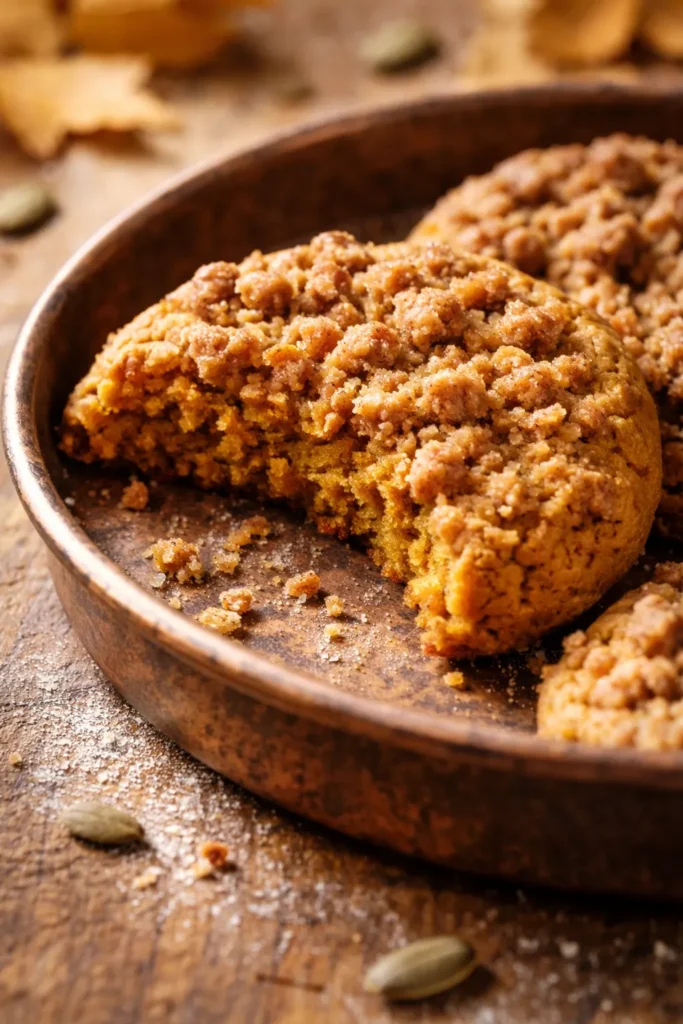
I tested this recipe across four weekends before I got it right. Batch one: cookies spread flat, streusel sank, glaze turned into a puddle. Batch two: too dry, too cakey, not enough spice. Batch three: close, but the streusel didn’t stay crunchy past day one. Batch four: that was the one — tall centres, distinct streusel topping that stayed crunchy for three days, and a glaze that set into perfect white ribbons. I made it again the next weekend to make sure it wasn’t luck. It wasn’t. Here’s what I learned in the process.
The oven temperature was the biggest variable. At 375°F, the edges browned too fast and the centres never set properly, which caused the streusel to sink into the dough. At 350°F, the cookies rose evenly, the streusel stayed on top, and the centres stayed soft without being gummy. I tested both temperatures on the same day with the same batch of dough — 350°F won by a wide margin. The chill step was the second biggest variable. Twenty minutes in the fridge firmed up the butter just enough to prevent spreading without hardening the dough so much that it cracked when I pressed the streusel on top. I tested chilled dough against unchilled dough six times across three batches. Chilled won every single time.
The spice ratio took two full batches to dial in. I wanted the pumpkin and spice to be present but not overwhelming — especially in the cookie base, where too much spice can taste artificial. A full tablespoon of pumpkin pie spice in the dough plus 2½ teaspoons in the streusel gave me that warm, layered flavour without any single spice dominating. The streusel needs to be bolder than the cookie because it’s competing with the sweetness of the glaze on top. If the streusel is too mild, it gets lost in the overall bite.
Why the Streusel Stays Crunchy (And Why You Need Pumpkin Puree That Isn’t Watery)
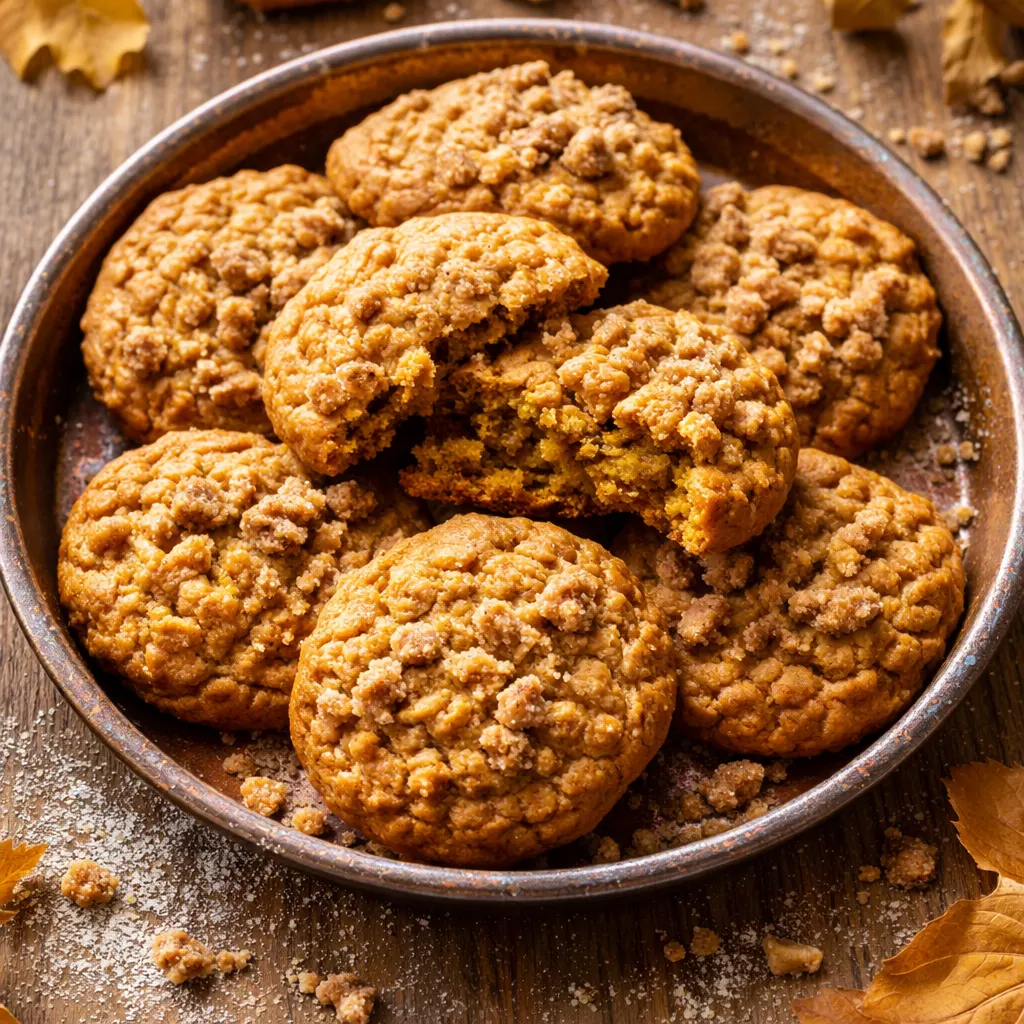
The streusel on these pumpkin coffee cake cookies doesn’t disappear into the dough like most streusel-topped baked goods. That’s because I bake the cookies at 350°F instead of 375°F. At 350°F, the cookie sets around the streusel rather than melting into it, so the topping stays distinct and crunchy. At 375°F, the edges brown faster than the centre sets, and the streusel sinks before the structure firms up. Most bakers find 350°F is the sweet spot for thick, soft cookies with a pronounced topping.
The other make-or-break ingredient is the pumpkin puree. Libby’s canned pumpkin works best because it’s consistently thick and not watery. If your puree looks loose or has liquid pooling on top, blot it with a paper towel before adding it to the dough. Too much moisture means flat cookies with a gummy centre — I’ve learned this the hard way more times than I’d like to admit.
What all this produces is a cookie that looks like it came from a bakery display case: domed, soft, crowned with buttery crumbs, and glazed just enough to catch the light. One cookie provides roughly 15% of the daily recommended intake of protein, per USDA nutritional data, so they’re not just delicious — they’re a decent snack too.
Everything You Need (And a Few Honest Notes From My Kitchen)
- 6 tbsp unsalted butter, softened (for streusel): The butter needs to be soft enough to press a finger into, but not melted. Melted butter makes the streusel greasy instead of crumbly.
- 3/4 cup (165 g) brown sugar, packed (for streusel): Pack it firmly into the measuring cup. Loosely packed sugar changes the texture and the streusel won’t hold together right.
- 3/4 cup (94 g) all purpose flour, spooned and leveled (for streusel): Spoon it into the cup and level it with a knife. Scooping directly from the bag packs in extra flour and makes the streusel dry.
- 2 1/2 tsp pumpkin pie spice (for streusel): Yes, that’s a lot. The streusel needs to be boldly spiced so it doesn’t get lost against the cookie base.
- pinch of salt (for streusel): Just a pinch. It balances the sweetness without making the streusel taste salty.
- 1/2 cup (122 g) canned pumpkin puree (for cookies): Libby’s canned pumpkin works best. Do not use pumpkin pie filling — it has sugar and spices already added and will throw off the whole recipe.
- 1 3/4 cups (219 g) all purpose flour, spooned and leveled (for cookies): Again, spoon and level. This is the most common mistake in cookie recipes — using too much flour makes them dry and cakey in a bad way.
- 1 tbsp pumpkin pie spice (for cookies): A full tablespoon. These are pumpkin cookies, and they should taste like it. Store-bought pumpkin pie spice works perfectly here.
- 1/2 tsp baking powder (for cookies): Gives the cookies a little lift without making them puff up too much.
- 1/2 tsp baking soda (for cookies): Helps the cookies spread just enough and keeps the centres soft.
- 1/2 tsp salt (for cookies): Use fine sea salt or table salt. Kosher salt has different volume measurements and may under-season the dough.
- 3/4 cup (168 g) unsalted butter, softened (for cookies): Room-temperature butter is not negotiable here. Cold butter won’t cream properly and warm butter makes the dough too slack. Leave it on the counter for about 45 minutes before you start.
- 1 cup (220 g) brown sugar, packed (for cookies): Packed brown sugar adds moisture and that deep molasses flavour that pairs so well with pumpkin.
- 2 egg yolks, at room temperature (for cookies): Room-temperature egg yolks (cold yolks seize the butter and make the dough stiff and hard to work with). Save the whites for an omelette or freeze them.
- 2 tsp vanilla extract (for cookies): Pure vanilla extract, not imitation. It rounds out the spice warmth without competing with the pumpkin.
- 1 cup (130 g) powdered sugar (for glaze): Sift it if it’s lumpy. Lumpy powdered sugar makes a bumpy glaze.
- 1 tsp vanilla extract (for glaze): Same rule — use the real stuff.
- 2-4 tsp whole milk (for glaze): Start with 2 teaspoons and add more a drop at a time until the glaze is thick but pourable. Whole milk gives the best consistency, but any milk works.
What to Pull Out Before You Start
- A hand mixer or stand mixer with paddle attachment — you can do this by hand with a wooden spoon, but it’ll take some elbow grease to cream the butter and sugar properly.
- Two medium mixing bowls — one for the streusel, one for the dry ingredients.
- One large mixing bowl — for the cookie dough.
- A 1.5-tablespoon cookie scoop — if you don’t have one, use two spoons to form even dough balls.
- Two baking sheets lined with parchment paper — parchment prevents sticking and helps the cookies bake evenly.
- A wire cooling rack — for cooling the cookies before glazing.
- A small whisk or fork — for the glaze.
If you don’t have a cooling rack, let the cookies cool on the baking sheet for a few extra minutes before transferring them to a plate — but the rack really does help the glaze set properly.
Let’s Make It — My Exact Process, Start to Finish
This recipe moves fast once you start, so I like to get the streusel made first and the dry ingredients measured out before I touch the butter. Trust me on that one.
Preheat and prep: Preheat your oven to 350°F. Line two baking sheets with parchment paper.
- Make the streusel: In a medium bowl, combine 6 tbsp softened unsalted butter, 3/4 cup packed brown sugar, 3/4 cup spooned-and-leveled all purpose flour, 2 1/2 tsp pumpkin pie spice, and a pinch of salt. Use a fork or your fingers to work everything together until it forms clumps ranging from pea-sized to marble-sized. Don’t over-mix it into a paste — you want uneven pieces so some are crunchy and some are crumbly. Set it aside.
- Mix the dry ingredients: In another medium bowl, whisk together 1 3/4 cups spooned-and-leveled all purpose flour, 1 tbsp pumpkin pie spice, 1/2 tsp baking powder, 1/2 tsp baking soda, and 1/2 tsp salt. Set this aside too.
- Cream the butter and sugar: In a large bowl, beat 3/4 cup softened unsalted butter and 1 cup packed brown sugar together on medium speed until light and fluffy — about 3 minutes. Scrape the sides of the bowl halfway through. You’ll know it’s ready when the mixture looks pale and feels airy when you lift the beater.
- Add the wet ingredients: Beat in 2 room-temperature egg yolks, one at a time, then 2 tsp vanilla extract. Scrape the bowl again. The mixture should look smooth and glossy. If it looks curdled, your butter was too cold or your egg yolks were too cold — but don’t panic, it’ll come together once you add the dry ingredients.
- Add the pumpkin: Beat in 1/2 cup pumpkin puree on low speed until just combined. The dough will look a little wet at this point — that’s normal.
- Add the dry ingredients: Gradually add the flour mixture to the wet mixture, mixing on low speed until just combined. Stop as soon as no streaks of flour remain. Over-mixing at this stage develops gluten and makes the cookies tough instead of tender.
- Scoop and top: Scoop the dough into 1.5-tablespoon portions (about the size of a golf ball) and place them 2 inches apart on the prepared baking sheets. Gently press a generous pinch of streusel onto the top of each dough ball — don’t press it into the dough, just let it sit on top. I use about 1 tablespoon of streusel per cookie.
- Chill the scooped dough: Pop the baking sheets into the fridge for 20 minutes. This is the step I begged you not to skip. Chilling firms up the butter so the cookies spread less and the streusel stays on top instead of sinking into the dough.
- Bake: Bake at 350°F for 10-12 minutes. At 10 minutes, the edges should be set and the centres should look slightly puffed and just barely golden. If you touch the centre lightly, it should feel soft but not raw. Let the cookies cool on the baking sheet for 5 minutes, then transfer to a wire rack to cool completely.
- Make the glaze: While the cookies cool, whisk together 1 cup powdered sugar, 1 tsp vanilla extract, and 2 tsp whole milk. If it’s too thick to drizzle, add another teaspoon of milk. If it’s too thin, add a tablespoon more powdered sugar. The consistency should be like thick cream — it should flow off the whisk in a ribbon but hold its shape for a second before disappearing.
- Glaze the cookies: Once the cookies are completely cool, drizzle the glaze over the tops using a spoon or a piping bag with a tiny tip cut off. I like to zigzag it over the streusel so every bite gets a little sweetness. Let the glaze set for about 15 minutes before stacking or serving.
How I Meal Prep These for the Week (Because One Batch Never Lasts Long Enough)
I make a double batch of the streusel ahead of time and keep it in the freezer. That way, when the pumpkin craving hits mid-week, I just need to whip up the cookie dough and I’m halfway there already. For the actual cookies, I’ve found they’re best baked fresh, but you can prep the dough a few ways.
- Fridge: Scoop the dough balls onto a plate, cover tightly with plastic wrap, and refrigerate for up to 3 days. Bake straight from the fridge — just add 1-2 minutes to the baking time. I do this all the time when I want fresh cookies without the full prep.
- Freezer: Yes, these freeze beautifully. Scoop the dough balls, place them on a parchment-lined baking sheet, and freeze until solid (about 1 hour). Transfer to a zip-top bag and freeze for up to 3 months. To bake, place frozen dough balls on a prepared sheet and bake at 350°F for 12-14 minutes — no need to thaw first. Add the streusel and glaze after baking.
- Reheat: For that just-baked texture, microwave a single cookie for 8-10 seconds. The glaze will soften slightly and the streusel will taste freshly crunchy. Don’t microwave more than one at a time — they get soggy in a pile.
Things I Wish I’d Known the First Time (After Making These 20+ Batches)
- Spoon and level the flour every single time: I know I’ve said this already, but I’m saying it again because it’s the difference between a cookie that bakes tall and a cookie that bakes flat. Scooping from the bag can add up to 25% more flour, which dries out the dough and makes the cookies crumbly instead of soft. Even if you mess this part up a little, it’ll still taste good — I’ve done it — but it won’t be the same texture.
- Don’t skip the 20-minute chill, even if you’re in a rush: I tried skipping it exactly once. The cookies spread into each other, the streusel sank into the dough like it was hiding from me, and the centres were gummy. The chill step takes almost no active time — just while you’re cleaning up — and it fixes basically every structural problem these cookies can have.
- Let the cookies cool completely before glazing: Warm cookies melt the glaze into a puddle that absorbs into the streusel and makes it soggy. I know it’s tempting to glaze them right away, but 15 extra minutes of patience pays off in a picture-perfect finish that lasts for days.
- Use a light hand with the streusel: It’s easy to pile it on, but too much streusel creates a thick, dense top layer that doesn’t bake through properly. A generous tablespoon per cookie is the sweet spot — enough to cover the surface without overwhelming the base.
Swaps That Actually Work (For When Pantry Items Run Low)
- Dairy-Free Version: Use vegan butter sticks (like Country Crock Plant Butter or Miyoko’s) in place of the butter in both the streusel and the cookie dough. For the glaze, swap whole milk for any unsweetened plant-based milk. The texture is marginally less tender, but honestly, most people won’t notice.
- Gluten-Free Adaptation: Substitute a good 1-to-1 gluten-free flour blend (like King Arthur Measure-for-Measure or Bob’s Red Mill 1-to-1) for the all purpose flour. The cookies will be slightly more delicate and may spread a tiny bit more, so chill the dough for 30 minutes instead of 20. The streusel works fine with the same substitution.
- Spice It Up or Down: If you don’t have pumpkin pie spice, substitute 2 tsp cinnamon, 1/2 tsp nutmeg, 1/2 tsp ginger, and 1/4 tsp cloves per tablespoon needed. If you prefer a milder spice profile, cut the pumpkin pie spice in the dough to 2 tsp — but keep the streusel at 2 1/2 tsp because it needs to stand out.
- Kid-Friendly Variation: Skip the glaze and sprinkle a pinch of coarse sugar (like turbinado or sanding sugar) over the streusel before baking. The sugar adds a crunchy top that kids love, and it eliminates the drippy glaze mess.
Troubleshooting
I’ve made these pumpkin coffee cake cookies more than twenty times, and I’ve seen almost everything go wrong at least once. Here are the most common problems and exactly how to fix them.
Why did my cookies spread flat instead of staying thick?
The most common cause is butter that was too soft or warm. If your butter was at room temperature for more than an hour, or if you creamed it for too long, the dough becomes slack and spreads immediately in the oven. The fix: chill the scooped dough for at least 30 minutes before baking. If you’re in a warm kitchen, I’d even go 40 minutes. I’ve been there — I once baked a batch at 9pm because I didn’t want to wait, and they came out paper-thin. It’s worth the extra time.
Why is my streusel sinking into the dough?
This happens when the dough is too warm or when the streusel is pressed too firmly into the top. Make sure your dough has been chilled for at least 20 minutes before adding the streusel, and gently place the streusel on top without pressing it in. If the streusel is made with butter that’s too soft, it will also sink more easily. Your streusel butter should be softened but not at all melted.
Why are my cookies dry and crumbly?
Two likely culprits: too much flour or over-baking. If you scooped your flour straight from the bag instead of spooning and leveling, you likely added 20-25% more flour than the recipe calls for. This dries out the dough and makes the cookies crumbly. If your flour measurement was correct, you may have baked the cookies 1-2 minutes too long. Pull them out when the centres still look slightly underdone — they continue to set on the hot baking sheet.
Why is my glaze too thin or too thick?
Glaze consistency is easy to fix. If it’s too thin (runs off the cookie like water), add powdered sugar one tablespoon at a time until it thickens. If it’s too thick (won’t flow off the spoon), add milk one teaspoon at a time. The ideal consistency is like thick cream — it should flow in a ribbon and hold its shape for a second before melting back into the bowl.
Can I use pumpkin pie filling instead of pumpkin puree?
No, please don’t. Pumpkin pie filling has added sugar, spices, and often thickeners that will completely change the chemistry of the dough. Your cookies will be overly sweet, overly spiced, and likely gummy. Stick with 100% pure pumpkin puree — Libby’s is my go-to because it’s consistently thick and not watery.
How do I know when the cookies are done without over-baking them?
Look for set edges that are just barely golden and centres that look puffed but still soft. If you press the centre gently with a finger, it should feel like a pillow — soft but not wet. The cookies will continue to set as they cool on the baking sheet, so pull them out when the centres still look slightly underdone. Over-baked pumpkin cookies turn dry and crumbly within hours.
Can I make these vegan?
Yes, with some adjustments. Use vegan butter sticks for both the streusel and the dough. Replace each egg yolk with 1 tablespoon of aquafaba (the liquid from a can of chickpeas) or a flax egg (1 tbsp ground flaxseed + 3 tbsp water, let sit for 5 minutes). The cookies will be slightly less tender and may spread a tiny bit more, so chill the dough for an extra 10 minutes. The glaze works beautifully with any plant-based milk.
Storage and Serving
How long do these cookies last, and how should I store them?
Store them in an airtight container at room temperature for up to 4 days. Layer them between sheets of parchment paper to prevent the glaze from sticking to the lid. The streusel will soften slightly after day two, but the flavour actually gets better — the spices bloom and meld together. If you live in a humid climate, add a silica gel packet (like the ones from beef jerky bags) to the container to keep the streusel crunchy.
Can I make these cookies ahead of time or freeze them?
Yes and yes. For make-ahead, you can prepare the dough and freeze the scooped balls (without streusel) for up to 3 months. Thaw overnight in the fridge, then top with streusel and bake as directed. For fully baked cookies, freeze them unglazed in an airtight container for up to 2 months. Glaze them after thawing and reheating for the best texture.
What’s the best way to reheat these cookies?
A quick 8-10 seconds in the microwave is my favourite method — it softens the centre and warms the glaze without melting it off. If you prefer a crunchy streusel, reheat in a 300°F oven for 3-4 minutes. Don’t use the microwave for more than one cookie at a time; they steam each other and turn gummy.
What do you serve with these cookies?
Honestly, they’re perfect on their own with a cup of coffee or hot apple cider. For a dessert spread, I love them next to a scoop of vanilla bean ice cream — the warm cookie against the cold ice cream is unbeatable. For a brunch board, arrange them alongside sliced pears, sharp cheddar, and a drizzle of honey. My personal favourite pairing is a mug of chai latte on a rainy Sunday afternoon — that combo is pure fall comfort.
I hope these cookies become as much a part of your fall rotation as they are mine. The first time you pull a tray out of the oven and see that streusel all golden and the glaze setting into perfect white ribbons, you’ll know exactly why I’ve made them 20 times.
If you try them, come back and tell me how they turned out — I love hearing about kitchen wins, near-misses, and everything in between. And if you find a way to make them even better, I’m all ears.
📌 These pumpkin coffee cake cookies with streusel and vanilla glaze bake thick and stay soft for days — save this recipe for your next fall baking session or weekend brunch.
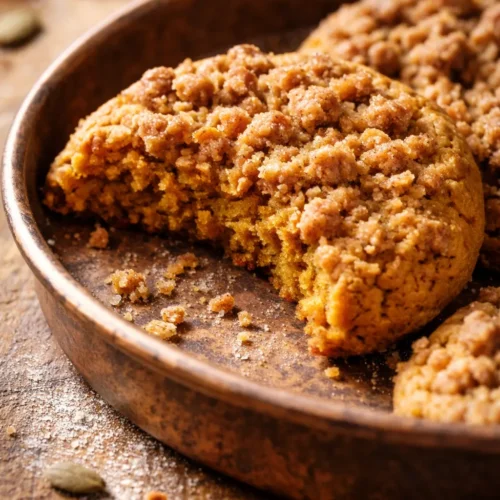
Pumpkin Coffee Cake Cookies That Taste Like Fall in Every Bite — Ready in 45 Minutes
Equipment
- Hand mixer or stand mixer with paddle attachment
- Medium Mixing Bowl
- Large Mixing Bowl
- 1.5-tablespoon cookie scoop
- Baking sheet lined with parchment paper
- Wire cooling rack
- Small whisk or fork
Ingredients
Streusel
- 6 tbsp unsalted butter, softened
- 3/4 cup brown sugar, packed
- 3/4 cup all purpose flour, spooned and leveled
- 2 1/2 tsp pumpkin pie spice
- pinch salt
Cookies
- 1/2 cup canned pumpkin puree Libby’s recommended
- 1 3/4 cups all purpose flour, spooned and leveled
- 1 tbsp pumpkin pie spice
- 1/2 tsp baking powder
- 1/2 tsp baking soda
- 1/2 tsp salt fine sea salt or table salt
- 3/4 cup unsalted butter, softened
- 1 cup brown sugar, packed
- 2 egg yolks, at room temperature
- 2 tsp vanilla extract pure vanilla extract
Glaze
- 1 cup powdered sugar sift if lumpy
- 1 tsp vanilla extract pure vanilla extract
- 2 tsp whole milk or up to 4 tsp as needed
Instructions
- Preheat your oven to 350°F. Line two baking sheets with parchment paper.
- Make the streusel: In a medium bowl, combine 6 tbsp softened unsalted butter, 3/4 cup packed brown sugar, 3/4 cup spooned-and-leveled all purpose flour, 2 1/2 tsp pumpkin pie spice, and a pinch of salt. Use a fork or your fingers to work everything together until it forms clumps ranging from pea-sized to marble-sized. Don’t over-mix it into a paste — you want uneven pieces so some are crunchy and some are crumbly. Set it aside.
- Mix the dry ingredients: In another medium bowl, whisk together 1 3/4 cups spooned-and-leveled all purpose flour, 1 tbsp pumpkin pie spice, 1/2 tsp baking powder, 1/2 tsp baking soda, and 1/2 tsp salt. Set this aside too.
- Cream the butter and sugar: In a large bowl, beat 3/4 cup softened unsalted butter and 1 cup packed brown sugar together on medium speed until light and fluffy — about 3 minutes. Scrape the sides of the bowl halfway through. You’ll know it’s ready when the mixture looks pale and feels airy when you lift the beater.
- Add the wet ingredients: Beat in 2 room-temperature egg yolks, one at a time, then 2 tsp vanilla extract. Scrape the bowl again. The mixture should look smooth and glossy. If it looks curdled, your butter was too cold or your egg yolks were too cold — but don’t panic, it’ll come together once you add the dry ingredients.
- Add the pumpkin: Beat in 1/2 cup pumpkin puree on low speed until just combined. The dough will look a little wet at this point — that’s normal.
- Add the dry ingredients: Gradually add the flour mixture to the wet mixture, mixing on low speed until just combined. Stop as soon as no streaks of flour remain. Over-mixing at this stage develops gluten and makes the cookies tough instead of tender.
- Scoop and top: Scoop the dough into 1.5-tablespoon portions (about the size of a golf ball) and place them 2 inches apart on the prepared baking sheets. Gently press a generous pinch of streusel onto the top of each dough ball — don’t press it into the dough, just let it sit on top. I use about 1 tablespoon of streusel per cookie.
- Chill the scooped dough: Pop the baking sheets into the fridge for 20 minutes. This is the step I begged you not to skip. Chilling firms up the butter so the cookies spread less and the streusel stays on top instead of sinking into the dough.
- Bake: Bake at 350°F for 10-12 minutes. At 10 minutes, the edges should be set and the centres should look slightly puffed and just barely golden. If you touch the centre lightly, it should feel soft but not raw. Let the cookies cool on the baking sheet for 5 minutes, then transfer to a wire rack to cool completely.
- Make the glaze: While the cookies cool, whisk together 1 cup powdered sugar, 1 tsp vanilla extract, and 2 tsp whole milk. If it’s too thick to drizzle, add another teaspoon of milk. If it’s too thin, add a tablespoon more powdered sugar. The consistency should be like thick cream — it should flow off the whisk in a ribbon but hold its shape for a second before disappearing.
- Glaze the cookies: Once the cookies are completely cool, drizzle the glaze over the tops using a spoon or a piping bag with a tiny tip cut off. I like to zigzag it over the streusel so every bite gets a little sweetness. Let the glaze set for about 15 minutes before stacking or serving.
Notes
Related posts:
 Soft, Pillowy White Chocolate Pumpkin Snickerdoodles with a Cinnamon-Sugar Crunch
 Pansy Sugar Cookies That Taste Like a Pastel Dream: Colorful, Buttery, and Surprisingly Easy to Make
 Caramel Apple Cookies for Cozy Autumn Afternoons: Soft, Chewy, and Drizzled with Salted Caramel
 White Chocolate Pumpkin Snickerdoodles: The Soft, Bakery-Style Version That Actually Works