
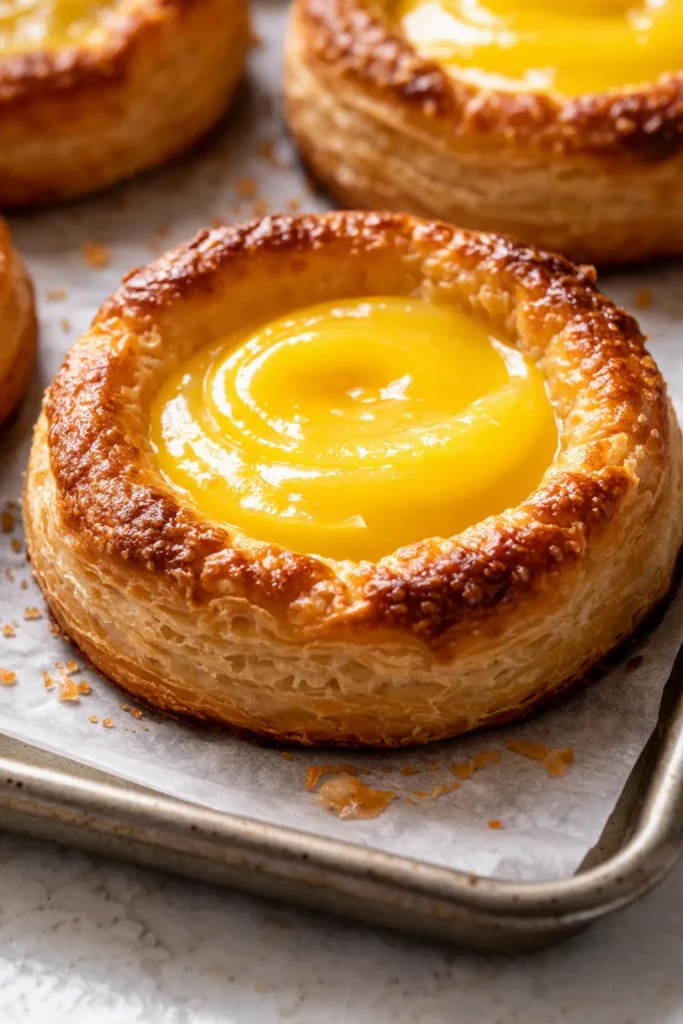
That first bite — when the pastry shatters into a hundred thin, buttery layers and the lemon curd lands bright and tart right in the center of your tongue — is the whole reason I make these. Not the powdered sugar. Not the raspberry on top. That bite. These lemon curd puff pastry tarts take twenty-five minutes of actual hands-on time, and they’re the thing I bring when I need a dish that looks like I tried too hard but actually took almost no effort. Store-bought puff pastry does the heavy lifting. I just give it structure and stand back.
The short version: Flaky, golden puff pastry shells filled with silky, tart-sweet lemon curd — on the table in about an hour, most of it thawing and baking.
I’ve made these for every brunch, baby shower, and school bake sale since Simone was old enough to reach the table without a booster seat. They go first, every single time. Marcus eats them straight off the sheet pan while they’re still warm, and I’ve stopped pretending I mind.
- Serves: 8 tarts
- Hands-On Time: 25 min | Total Time: 1 hr 15 min
- Difficulty: Easy — the pastry does the heavy lifting, the curd just needs eight minutes of your full attention
- Cost per serving: ~$1.20
- Calories: ~260 per tart
- Dietary Notes: Vegetarian. The curd is naturally gluten-free; the pastry needs real wheat flour to get those layers. Dairy-free swap in the variations below.
(Photo above: overhead shot of eight golden puff pastry tarts on a white platter, each filled with bright yellow lemon curd and topped with two fresh raspberries, a light dusting of powdered sugar, natural morning light from the left, a linen napkin tucked under the corner of the platter.)
The Trick That Keeps These Crispy (I Learned It the Hard Way)
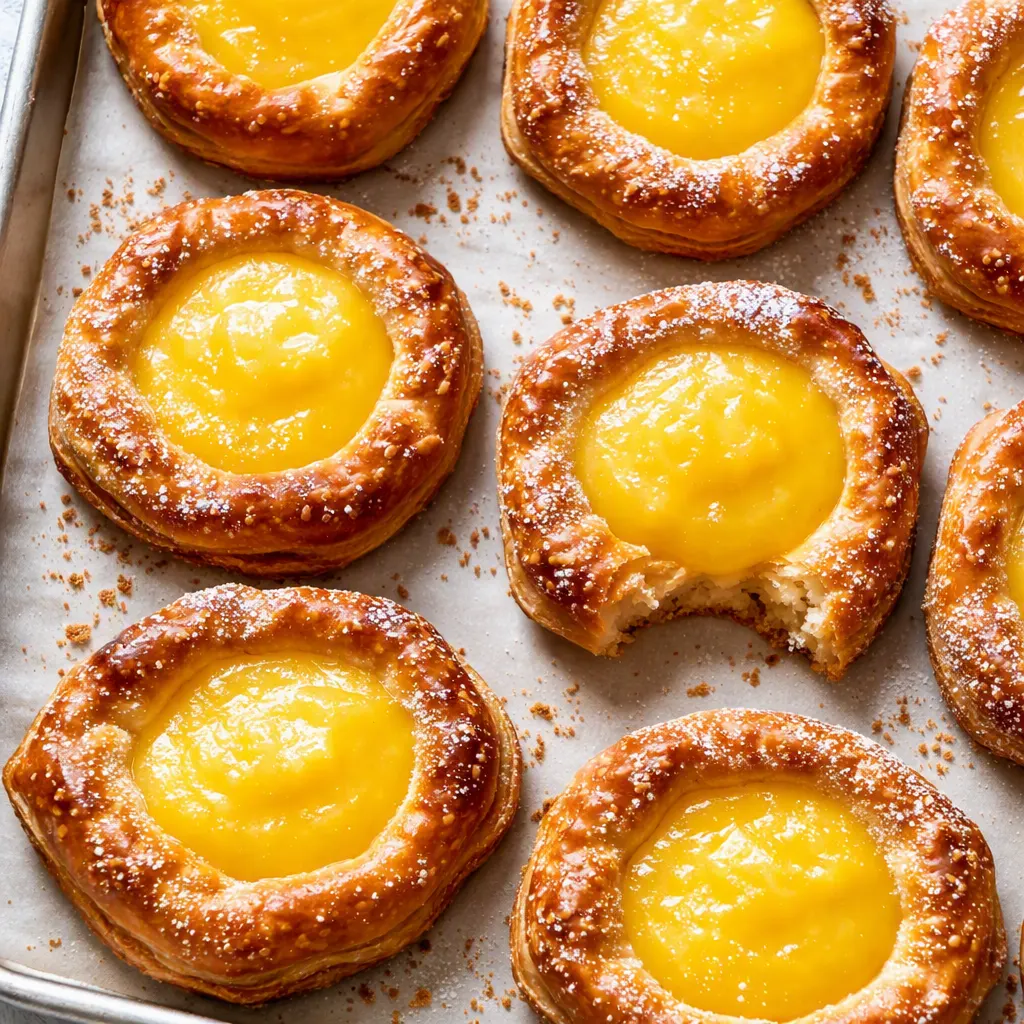
The first time I made these, I filled the pastry with curd and baked it that way. Beautiful in theory, a soggy disappointment in practice. The curd bubbled over the edges, soaked into the layers, and turned the whole thing into something that tasted right but had no crunch. I stood in the kitchen and ate three of them anyway, because they were still good. But I was annoyed.
The fix turned out to be simple: bake the shells first, press a well into the center while they’re still warm, and spoon the curd in after. The edges puff up tall and stay shatter-crisp, because the curd never touches them. And the centers stay flat, because you dock them — poking them all over with a fork so they don’t balloon into air pockets. Border puffs, center stays put, curd goes in last. That’s the whole architecture.
One more thing: egg wash the borders only. Brushing the whole shell makes the centers bake dark and tough before the edges finish, and it leaves a faint cooked-egg taste where you don’t want it. Border only.
The result is a tart that still cracks when you bite into it an hour after it’s out of the oven. That’s the version worth making.
Everything You Need (And a Few Notes From Me)
- 1 sheet frozen puff pastry, thawed (half of a 17.3-ounce box): The whole foundation. If you can find all-butter puff pastry, spend the extra couple of dollars — you’ll taste it in the layers. The regular store brand works fine; I use whatever’s at my grocery store. Thaw it overnight in the fridge, not on the counter. Fridge-thawed pastry cuts cleanly and puffs evenly. Simone’s review of the pastry alone was, and I quote, “why don’t we eat this every day,” which is a question I still don’t have a good answer for.
- 3 large egg yolks: For the curd. The whites go into the egg wash, so nothing gets wasted.
- ½ cup (100g) granulated sugar: Enough to balance the lemon without hiding it. This is a tart curd, not a candy.
- ⅓ cup (80 ml) fresh lemon juice, from 2 to 3 lemons: Non-negotiable. Fresh juice only — bottled lemon juice tastes flat and metallic, and it will turn your curd into something that tastes like a cleaning product. I’m sorry, but that’s the truth. Celestine didn’t make curd, but she made the lemonade for church suppers for forty years, and she had exactly the same rule about lemons.
- 1 tablespoon lemon zest: The zest carries the lemon perfume that the juice can’t. Zest before you juice, and keep the grater away from the white pith — that part is bitter.
- 6 tablespoons (85g) cold unsalted butter, cut into small cubes: Whisked in off the heat at the end. It emulsifies the curd and gives it that silky, mouth-coating texture. Cheap butter tastes cheap in a recipe this simple. Use the good stuff.
- Pinch of salt: Don’t skip it. It sharpens the lemon and keeps the sugar from flattening everything out.
- 1 large egg + 1 tablespoon water (egg wash): The difference between homemade-looking and bakery-looking. Brush it only on the borders, like you’re painting the frame of each tart.
- Powdered sugar, for dusting: Do this right before serving, or it melts into the curd and disappears.
- Fresh raspberries or blueberries (optional): The tart berries against the bright curd is the whole top note. Simone says the berries are not optional. Technically they are. She’s right, though.
Jarred curd shortcut: ¾ cup of a good jarred lemon curd — not the one that’s mostly corn syrup — will absolutely work here. Let it come to room temperature and spoon it in after the shells bake. I make the curd from scratch most of the time because it’s eight minutes and a completely different flavor, but the jarred path is a perfectly fine Sunday. No judgment either way.
The Setup (It’s Minimal, I Promise)
- Rimmed baking sheet — the rim matters; things slide off lipless pans
- Parchment paper
- Sharp knife or a pizza cutter for clean edges
- A fork, for docking the centers
- Pastry brush, for the egg wash
- Small saucepan, whisk, fine-mesh strainer, and a zester (only if you’re making the curd)
- A small measuring cup or the back of a spoon, for pressing the wells
That’s genuinely it. You probably own all of it already.
Let’s Make It (Step by Step)
Read this through once before you start. The curd does not like to be rushed, and the pastry goes fast once it hits the oven.
First, the curd — if you’re using jarred, skip to step 5:
- Zest and juice: Zest 2 to 3 lemons until you have 1 tablespoon, then juice them into a measuring cup until you hit a third of a cup. Zest first, juice second — a lemon that’s already been juiced is miserable to zest. (📸 Photo tip: your zest should be bright yellow with no white pith. If you see white, you grated too deep, and that’s the bitter part. The curd will still taste good, so don’t panic.)
- Whisk: In a small saucepan, whisk the yolks, sugar, and zest together for a full minute, until the sugar is mostly dissolved and the mixture turns pale yellow. Whisk in the lemon juice. It will look thin. That’s normal.
- Cook: Set the pan over medium-low heat and stir constantly with the whisk. No breaks. The difference between curd and sweet scrambled eggs is about thirty seconds. Cook for 6 to 8 minutes, until it thickens enough to coat the back of a spoon and hold a clean line when you drag your finger through it.
- Finish: Pull the pan off the heat and whisk in the cold butter, a few cubes at a time, letting each addition melt before the next. Stir in the pinch of salt. Taste it now, because this is when the whole recipe gets decided — you want the lemon bright, the sugar just enough, and the salt invisible but present. Pour through a fine-mesh strainer into a small bowl, pressing the curd through with a spatula. Press a piece of plastic wrap directly onto the surface so it doesn’t form a skin, and put it in the fridge while you do the pastry.
Now the pastry:
- Preheat: Preheat the oven to 400°F with a rack in the middle. Line a rimmed baking sheet with parchment.
- Cut: On a lightly floured surface, unfold the thawed puff pastry. If it cracked during thawing, give it two minutes at room temperature before you touch it. Cut it into 8 equal rectangles — no need to re-roll scraps, just trim the edges straight.
- Score and dock: Score a line ½ inch in from each edge with a knife, cutting about halfway through. Poke the inside of each rectangle all over with the fork, about every inch. This is the step that keeps the centers flat while the borders puff into golden walls. (📸 Photo tip: each tart should look like a stitched frame — a tidy perforated rectangle inside a clean border, ready to rise.)
- Brush: Whisk the egg with a splash of water until it’s uniform. Brush only the borders — the half-inch rim around the edge of each rectangle. Not the centers. (📸 Photo tip: you want a clean gold frame on each tart, with the center still pale and unbrushed. That contrast is the bakery look.)
- Bake: Bake for 16 to 20 minutes, until the borders are tall, deep golden brown, and dry-looking. If your oven runs hot, check at 14. They should look like golden picture frames with pale parchment centers.
- Press the wells: The moment they come out of the oven, press the center of each one down with the back of a small measuring cup or the back of a spoon. You’re making the bowl for the curd. Do this while they’re hot, or the pastry will crack instead of give. A little crack is fine — the curd covers it.
- Rest and fill: Cool the shells on the pan for 10 minutes; they finish crisping as they settle. Spoon the curd into each well, about 1½ tablespoons per tart, then top with raspberries and dust with powdered sugar right before serving. If I’m really tired, I use jarred curd and skip the straining — the whole thing takes twenty minutes and nobody notices.
Make-Ahead Notes (Because We’re All Busy)
The smart money is on making the pieces ahead and assembling right before you serve. Here’s how that looks in my kitchen:
- Fridge: The curd keeps up to 5 days in a sealed jar. It thickens as it chills, so let it sit at room temperature for 15 minutes before filling. Baked unfilled shells keep overnight in a sealed container.
- Freezer: Unfilled baked shells freeze well for up to a month, and the curd freezes, too — thaw it in the fridge overnight and whisk it smooth. Don’t freeze filled tarts. The curd turns the pastry soft, and soft isn’t the point of this recipe.
- Reheat: Re-crisp the shells at 350°F for 5 to 6 minutes before filling, then fill and serve. Nobody will know they weren’t just baked. If you want warm filled tarts, warm them at 300°F for 5 minutes — the pastry stays crisp enough, and the curd turns jammy.
My Honest Advice After Making These a Lot of Times
- Thaw the pastry in the fridge, not the counter: Counter-thawed pastry gets sticky on the surface within minutes, and sticky pastry fights you at every step — it sticks to the knife, the parchment, your fingers. Overnight in the fridge gives you cold, cooperative pastry that cuts clean and puffs even. If you forgot to thaw it, the counter is fine for up to 40 minutes; it should still feel cold, just pliable.
- Don’t skip the docking: The fork marks are what keep the centers from ballooning into bubbles while the borders rise. Skip it, and you’ll be pressing a hot balloon down while the edges lose their height. The fork takes five seconds. Just do it.
- Egg wash the border, not the whole thing: There’s a pattern in the comments on my site, and it’s always the same: “why did my center bake darker than the edges?” The answer is always the egg wash. Center egg wash bakes dark, tough, and a little eggy right where the curd should be. Border only.
- The curd is ready when it coats the spoon: Not when it looks thick — when it coats. Drag your finger through the coating; if the line holds, stop. It’ll still look loose in the pan, but it firms up as it cools. Overcooked curd turns into lemon jello. Still good, just different.
- Even if you mess it up, it’s still good: I have pressed too hard and torn the pastry. I have filled with slightly warm curd and lost some of the crunch. I have dropped a tart on the floor and served it anyway — the floor was clean. Every single version got eaten. The worst lemon curd puff pastry is still buttery, lemon-y, and gone by the end of the afternoon.
Swaps That Actually Work (Because We Don’t All Eat the Same)
- Dairy-free: Use a good vegan butter in the curd — the rich, cultured kind, not the watery tub — and check your puff pastry box; the plain frozen ones are often dairy-free already. The all-butter ones aren’t. I’ve tested the curd with a reader-favorite vegan butter and it holds up beautifully.
- Gluten-free: The curd is naturally gluten-free, so if that’s the only issue, serve it in little cups with berries and a crisp cookie. But don’t try the gluten-free boxed puff pastry here — I tested one and it doesn’t puff; it comes out like a cracker. Fine for other things. Not right for this.
- Lime or half-lemon, half-lime: Swap the juice and zest for lime, or do a mix of both fruits. Lime curd is possibly even more delicious — bright and almost tropical, unreal in July. This is my summer version.
- The kid version: Leave the berries off, or add a scatter of rainbow sprinkles after the powdered sugar. Simone says sprinkles make everything funnier, and I don’t argue with her about food anymore. She was right about the lemon, and she’s right about this.
- The company version: Add a dollop of barely sweetened whipped cream or mascarpone, or a small spoonful of berry jam under the curd. I did the jam version for a baby shower once, and the platter came back empty.
Questions I Get About These All the Time
Q: Why did my lemon curd turn out scrambled?
A: I’ve been there, and I’ve eaten the evidence. The heat was too high, or you stepped away from the whisk — or both. The fix is easy: pour it through a fine-mesh strainer and it smooths right out; you’ll lose a few cooked bits but no flavor. Next batch, keep the heat at medium-low and stir the whole time. The curd will be perfect.
Q: Can I use bottled lemon juice?
A: I’m going to be honest with you: no. Bottled juice tastes flat, and the stabilizers give the curd a metallic edge. If you don’t have fresh lemons, use a good jarred curd instead — this recipe deliberately works with both paths. The pastry is the star either way.
Q: How long do these keep, and can I freeze them?
A: Filled tarts are best the same day — the curd is too moist to keep the pastry crisp overnight. It won’t ruin them, just soften them. The curd alone keeps 5 days in the fridge and up to 3 months in the freezer. Unfilled baked shells freeze for a month and re-crisp in a 350°F oven for 5 to 6 minutes before you fill them. Filled tarts: don’t freeze. The texture is worth protecting.
Q: What do you serve with these?
A: In my house, they’re Saturday breakfast — strong coffee, and the morning light on the back porch, which is my favorite way to eat them. For a brunch table, they’re the sweet thing next to something savory, like a frittata or a ham biscuit. For dessert, vanilla ice cream is the only companion they need. For a shower or a tea party, just put them on a nice plate. They’re already pretty.
More Recipes My Family Makes on Repeat
If these disappear at your table the way they do at mine, here are a few others that get the same reaction:
- [INTERNAL LINK PLACEHOLDER: Brown Butter Peach Galette] — the one I make when peaches are actually good, all shaggy and golden, with a crushed-almond crust that looks fancy and takes no skill whatsoever
- [INTERNAL LINK PLACEHOLDER: Strawberry Hand Pies That Don’t Leak] — the bake-sale favorite that stays crisp and never weeps on the pan, and yes, I learned that one the hard way too
- [INTERNAL LINK PLACEHOLDER: My Grandma’s Buttermilk Biscuits] — tall, flaky, the ones Celestine made when she wanted the whole block to smell like Sunday morning
These lemon curd puff pastry tarts are the answer to the question every home cook actually asks: what do I make that looks like I planned it for days but took twenty-five minutes of hands-on time and one box of store-bought pastry? This is that. They’re the first thing gone at every table they land on, and they’ll be the same at yours.
If you make them — from-scratch curd or the jarred stuff, I don’t care — come back and tell me in the comments. I love hearing what your family thought, what you swapped, or whether you found a better berry situation than the one I use. And if you’re on Pinterest, tag me when you save it. I love seeing these show up on other people’s tables.
📌 This lemon curd puff pastry recipe stays shatteringly crisp for hours — save it for your next brunch table, baby shower, or slow Saturday morning.
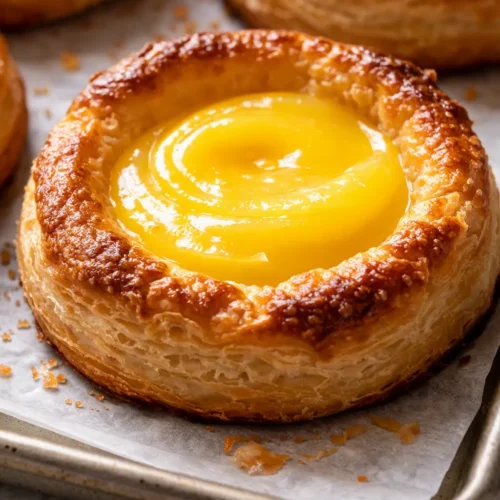
Lemon Curd Puff Pastry Tarts
Equipment
- Rimmed Baking Sheet
- Parchment Paper
- Sharp knife or pizza cutter
- Fork
- Pastry brush
- Small saucepan
- Whisk
- Fine-mesh strainer
- Zester
- Small Measuring Cup or Spoon
Ingredients
Lemon Curd
- 3 large egg yolks
- 1/2 cup granulated sugar (100g)
- 1/3 cup fresh lemon juice (80 ml), from 2 to 3 lemons
- 1 tablespoon lemon zest
- 6 tablespoons cold unsalted butter (85g), cut into small cubes
- 1 pinch salt
Pastry and Assembly
- 1 sheet frozen puff pastry, thawed (half of a 17.3-ounce box)
- 1 large egg + 1 tablespoon water (egg wash)
- Powdered sugar, for dusting
- Fresh raspberries or blueberries (optional)
Instructions
- Zest 2 to 3 lemons until you have 1 tablespoon, then juice them into a measuring cup until you hit a third of a cup. Zest first, juice second — a lemon that is already juiced is miserable to zest.
- In a small saucepan, whisk the yolks, sugar, and zest together for a full minute, until the sugar is mostly dissolved and the mixture turns pale yellow. Whisk in the lemon juice. It will look thin. That is normal.
- Set the pan over medium-low heat and stir constantly with the whisk. No breaks. Cook for 6 to 8 minutes, until it thickens enough to coat the back of a spoon and hold a clean line when you drag your finger through it.
- Pull the pan off the heat and whisk in the cold butter, a few cubes at a time, letting each addition melt before the next. Stir in the pinch of salt. Taste it now. Pour through a fine-mesh strainer into a small bowl. Press plastic wrap directly onto the surface and put it in the fridge while you do the pastry.
- Preheat the oven to 400°F with a rack in the middle. Line a rimmed baking sheet with parchment.
- On a lightly floured surface, unfold the thawed puff pastry. If it cracked during thawing, give it two minutes at room temperature before you touch it. Cut it into 8 equal rectangles — no need to re-roll scraps, just trim the edges straight.
- Score a line 1/2 inch in from each edge with a knife, cutting about halfway through. Poke the inside of each rectangle all over with the fork, about every inch.
- Whisk the egg with a splash of water until it is uniform. Brush only the borders — the half-inch rim around the edge of each rectangle. Not the centers.
- Bake for 16 to 20 minutes, until the borders are tall, deep golden brown, and dry-looking. If your oven runs hot, check at 14. They should look like golden picture frames with pale parchment centers.
- The moment they come out of the oven, press the center of each one down with the back of a small measuring cup or the back of a spoon. Do this while they are hot, or the pastry will crack instead of give. A little crack is fine — the curd covers it.
- Cool the shells on the pan for 10 minutes; they finish crisping as they settle. Spoon the curd into each well, about 1 1/2 tablespoons per tart, then top with raspberries and dust with powdered sugar right before serving.
Notes
Related posts:
 Low Calorie Banana Bread That Doesn’t Taste Like a Compromise — Finally
 Puff Pastry Apple Tarts That Look Like a Bakery Made Them — with Only 15 Minutes of Effort
 Peach Cobbler That Bakes Its Own Crust (Golden, Juicy, 40 Minutes)
 No-Bake Butterfinger Pie That’s Creamy, Crunchy, and Ready in 20 Minutes