
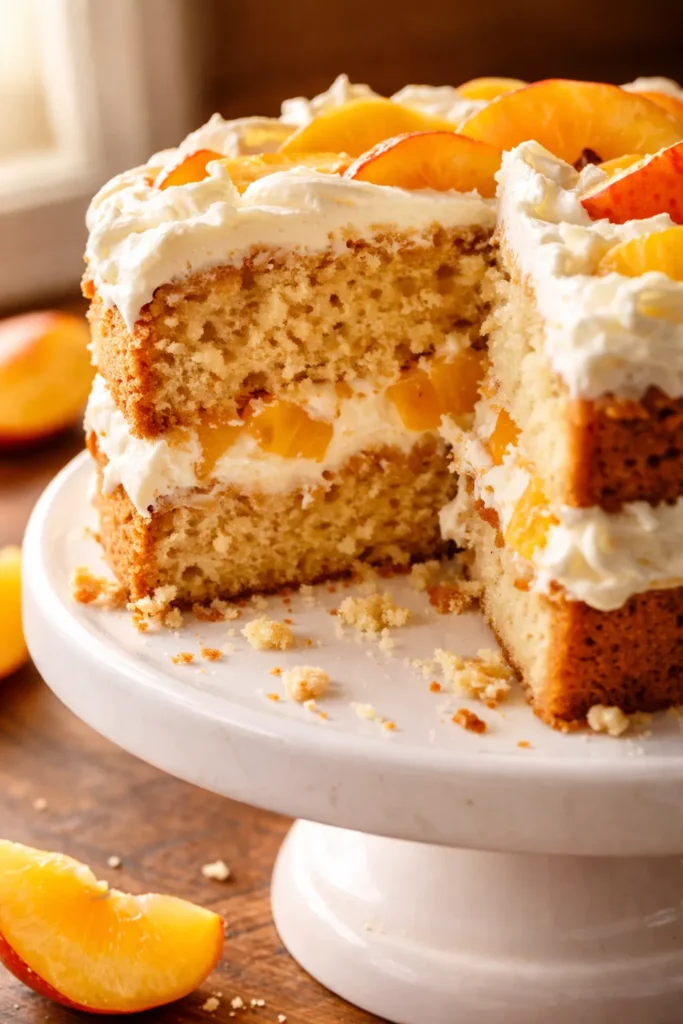
There’s nothing quite like the moment you cut into a tall, fluffy cake and see those layers of peaches and cream. I’ve lost count of how many times I’ve baked this cake for summer cookouts, birthdays, and just because it’s Tuesday. Each time, someone takes a bite and pauses. The vanilla cake is so tender it practically dissolves on your tongue, and the peach-flecked whipped cream frosting tastes like July in a bowl.
This isn’t a fussy, complicated recipe. It’s the kind of dessert that makes you look like a rockstar without requiring a pastry degree. The secret is pureeing ripe peaches right into the whipped cream — no buttercream, no heavy syrups. The result is a cake that stays moist and sliceable for two days (if it lasts that long).
My Journey to the Perfect Peach Cake: A Testing Narrative
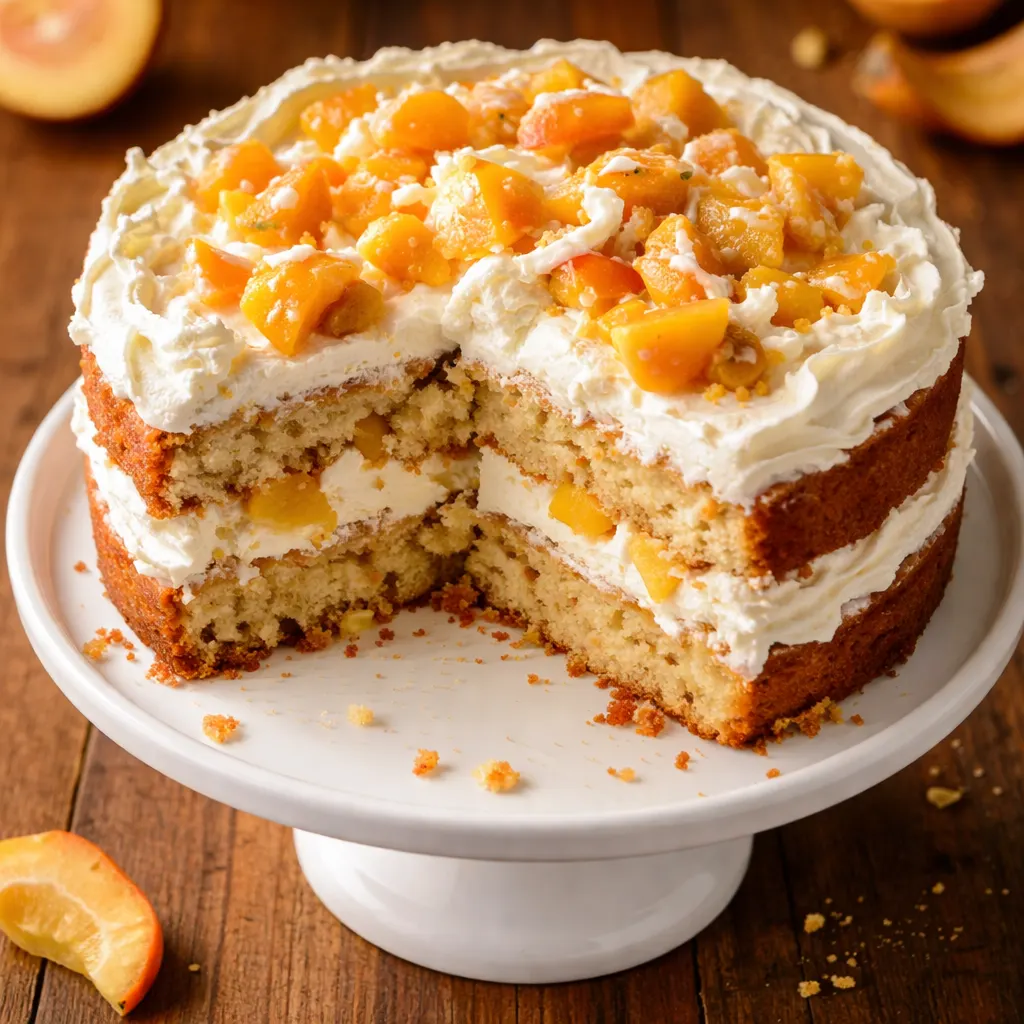
The first time I attempted this cake, I was impatient. The butter was still cool, the eggs straight from the fridge, and I overmixed the batter. The layers came out dense and domed like little volcanoes — a textbook failure. I realized I had rushed the creaming step and used cold eggs. I went through three batches before I got it right.
Batch two taught me that room-temperature ingredients aren’t just a suggestion. I set a timer for a full three minutes of creaming the sugar and butter on medium speed. The mixture turned pale and airy, and when I added the eggs (which I’d let sit in a bowl of warm water for five minutes), they emulsified smoothly. The batter looked like thick, glossy ribbons. Those layers baked up beautifully — golden, level, and springy to the touch.
But the real breakthrough was the peach purée. Using canned peaches felt wrong for a summer cake. I bought a bag of fragrant, freestone peaches and blitzed them in the food processor. That fresh, bright flavor took the frosting from good to unforgettable. The natural pectin in the fruit also stabilized the cream just enough so it didn’t weep overnight. I knew I had a winner.
In my experience, the key is patience: let the butter and eggs come to room temperature, cream for a solid three minutes, and use fresh peaches. That’s the fix that turns a dense disaster into a showstopper.
What You Need: Ingredients With a Few Pro Tips
- 2 cups all-purpose flour — Spoon and level it. 250g if you have a scale. Scooping from the bag packs in too much flour and makes the cake dry.
- 1½ cups granulated sugar — Regular white sugar works best. It dissolves easily and gives the cake a tender crumb.
- 1 tablespoon baking powder — Test it for freshness: drop a little in hot water; it should fizz vigorously.
- ½ teaspoon salt — A pinch of salt makes the peaches taste more peachy.
- ½ cup unsalted butter, room temperature — Leave it out for at least an hour. If you’re in a hurry, cut it into small cubes and let it soften for 15 minutes.
- 4 large eggs — Also room-temperature. Place them in a bowl of warm water for 5 minutes if you forgot.
- 1 teaspoon vanilla extract — Pure vanilla, not imitation. It adds warmth to the fruit.
- 1 cup milk — Whole milk gives the richest texture, but 2% works too.
- For the frosting: 1 cup heavy whipping cream (don’t even try half-and-half) and 2 ripe peaches, pureed.
- For garnish: 1 extra peach, thinly sliced, plus a squeeze of lemon juice to keep them from browning.
Tools You’ll Need
- Oven preheated to 350°F (175°C)
- Two 8-inch round cake pans (9-inch also works; layers will be slightly shorter)
- Parchment paper rounds (don’t skip them!)
- Mixing bowls — one large, one medium, one for whipping cream (metal or glass, chilled)
- Whisk for dry ingredients
- Electric hand mixer or stand mixer with paddle attachment
- Rubber spatula for folding
- Wire cooling rack
- Serrated knife for leveling
The Step-by-Step Method
I like to think of this as three easy stages: make the batter, bake the layers, whip up the peach cream. Here’s the play-by-play.
1. Prep and Dry Ingredients
Preheat the oven to 350°F (175°C). Grease your cake pans with butter or nonstick spray, then line the bottoms with parchment paper. In a medium bowl, whisk together the flour, baking powder, and salt until evenly combined. Set aside.
2. Cream Butter and Sugar
In a large bowl (or the bowl of your stand mixer), beat the softened butter and sugar together on medium speed for a full 3 minutes. Stop and scrape the sides once. The mixture should look pale and fluffy — this is where the cake gets its lightness. I’ve found that setting a timer prevents me from rushing.
3. Add Eggs and Vanilla
Crack the eggs in one at a time, beating well after each addition. The batter might look a little curdled at first; that’s normal. Beat in the vanilla. The mixture should be thick and glossy.
4. Alternate Dry and Wet
With the mixer on low, add about one-third of the flour mixture. Then half the milk. Another third of flour. The rest of the milk. End with the remaining flour. Mix only until the streaks disappear — overmixing develops gluten and makes the cake tough. Scrape the bowl once during this process.
5. Bake and Cool
Divide the batter evenly between the two pans. Bake for 25–30 minutes, rotating halfway through. The tops will be golden, the edges will pull away from the sides, and a toothpick inserted in the center should come out clean or with just a few moist crumbs. Cool the cakes in the pans for 10 minutes, then turn them out onto a wire rack and let them cool completely. This is important: if the cake is even slightly warm, the frosting will melt.
6. Make the Peach Cream Frosting
Just before you’re ready to assemble, pour the cold heavy cream into a chilled bowl. Whip on medium-high until stiff peaks form. Gently fold in the peach purée with a rubber spatula — fold just until incorporated. Overfolding will deflate the cream. If it seems too soft, pop it in the fridge for 10 minutes to firm up.
7. Assemble Like a Pro
If you want a dramatic four-layer cake, use a serrated knife to slice each cake layer in half horizontally. Place the first layer on your serving plate. Spread about ¼ of the peach cream evenly over the top. Repeat with remaining layers. For the top, spread the last of the cream, letting it cascade slightly over the sides for a rustic look. Arrange fresh peach slices on top.
A Few Swaps That Work
- Gluten-free: Use a 1:1 gluten-free all-purpose flour blend. If it doesn’t contain xanthan gum, add ½ teaspoon. The cake will be a bit more delicate.
- Dairy-free: Substitute the butter with vegan butter (Miyoko’s is my favorite) and use full-fat oat or coconut milk. For the frosting, chill a can of full-fat coconut cream overnight and whip it with the peach purée.
- Other stone fruits: Ripe nectarines or apricots work beautifully. They’re a little tarter, so add 1 tablespoon of sugar to the purée if desired.
- Spiced version: Add 1 teaspoon cinnamon and ¼ teaspoon nutmeg to the dry ingredients. It gives the cake a peach-cobbler warmth.
How to Store This Cake (and Make It Ahead)
The cake layers can be baked a day ahead. Cool completely, wrap tightly in plastic, and store at room temperature. The peach cream frosting is best made on the day you serve it, but you can puree the peaches the night before and keep the purée refrigerated.
- Refrigerator: Store the assembled cake in a cake carrier for up to 2 days. The frosting will soften slightly but still holds.
- Freezer: Unfrosted cake layers can be wrapped in plastic and foil and frozen for up to 1 month. Thaw at room temperature before frosting.
- Serving tip: If refrigerated, let slices sit at room temperature for 15 minutes before serving for the best flavor and texture.
Troubleshooting Your Peaches and Cream Layer Cake
Q: Why did my cake sink in the middle?
A: This usually happens when the oven door is opened too early (before the 20-minute mark) or when the butter and sugar weren’t creamed long enough. Also make sure your baking powder is fresh. In my early attempts, I learned to cream for the full three minutes and resist peeking — that fixed the sinking issue immediately.
Q: Can I use frozen peaches?
A: Yes, but thaw them completely and drain off the excess liquid before pureeing. Pat them dry with paper towels. Frozen peaches release more water, which can thin the frosting. I always strain the purée through a fine-mesh sieve if I’m using frozen.
Q: How do I know when the cake is done?
A: The top will be golden, the edges will pull away from the pan, and a toothpick inserted into the center will come out with a few tender crumbs — not wet batter. The top should spring back when lightly touched.
Q: Can I make this cake vegan?
A: Absolutely. Replace the eggs with 4 flax eggs (4 tablespoons ground flax + 12 tablespoons water). Use melted coconut oil instead of butter, and plant-based milk. For the frosting, use chilled coconut cream as described above. The texture will be slightly denser but still delicious.
Q: Why is my frosting runny?
A: Either the cream wasn’t whipped to stiff peaks, the peach purée was too watery, or the cream wasn’t cold enough. Make sure your bowl and beaters are chilled, and gently fold the purée after whipping. If the purée seems very liquid, strain it through a fine-mesh sieve first. I learned this after a particularly soupy batch — now I always chill the bowl and whip until the peaks stand tall.
Q: How long does this cake last?
A: In the fridge in a sealed container, it’s best within 2 days. After that, the whipped cream begins to separate and the cake may dry out. Bring slices to room temperature before serving for the best flavor.
What to Serve With It
This cake is lovely on its own, but for an extra-special presentation, try a dollop of extra whipped cream, a drizzle of honey, or a scoop of vanilla ice cream. For a grown-up twist, I sometimes splash a little amaretto over the peach slices before serving. Pair it with a tall glass of iced tea or a cold brew coffee on a warm summer afternoon.
I hope this cake becomes your go-to for summer celebrations, just as it is mine. If you give it a try, drop a comment below and let me know how it turned out — I love hearing your stories. Happy baking!
📌 Save this recipe for your next summer party — a peaches and cream layer cake that stays light and juicy for days.
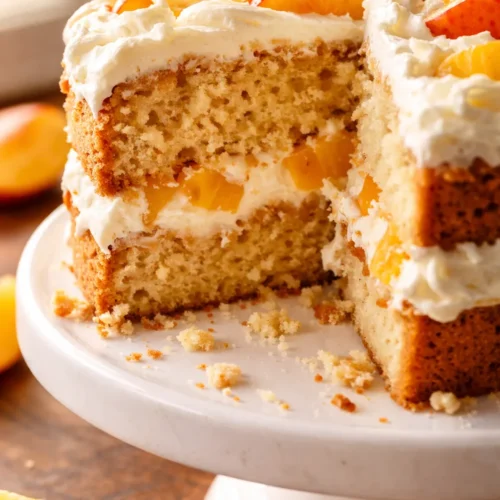
The Peaches and Cream Layer Cake That Tastes Like Summer in Every Bite (No Box Mix Needed)
Equipment
- Oven
- Two 8-inch round cake pans
- Parchment paper rounds
- Mixing Bowls
- Whisk
- Electric hand mixer or stand mixer
- Rubber spatula
- Wire cooling rack
- Serrated Knife
Ingredients
Cake
- 2 cups all-purpose flour Spoon and level it. 250g if you have a scale. Scooping from the bag packs in too much flour and makes the cake dry.
- 1½ cups granulated sugar Regular white sugar works best. It dissolves easily and gives the cake a tender crumb.
- 1 tablespoon baking powder Test it for freshness: drop a little in hot water; it should fizz vigorously.
- ½ teaspoon salt A pinch of salt makes the peaches taste more peachy.
- ½ cup unsalted butter, room temperature Leave it out for at least an hour. If you’re in a hurry, cut it into small cubes and let it soften for 15 minutes.
- 4 large eggs Also room-temperature. Place them in a bowl of warm water for 5 minutes if you forgot.
- 1 teaspoon vanilla extract Pure vanilla, not imitation. It adds warmth to the fruit.
- 1 cup milk Whole milk gives the richest texture, but 2% works too.
Frosting
- 1 cup heavy whipping cream Don’t even try half-and-half.
- 2 ripe peaches, pureed
Garnish
- 1 extra peach, thinly sliced Plus a squeeze of lemon juice to keep them from browning.
Instructions
- Preheat the oven to 350°F (175°C). Grease your cake pans with butter or nonstick spray, then line the bottoms with parchment paper. In a medium bowl, whisk together the flour, baking powder, and salt until evenly combined. Set aside.
- In a large bowl (or the bowl of your stand mixer), beat the softened butter and sugar together on medium speed for a full 3 minutes. Stop and scrape the sides once. The mixture should look pale and fluffy — this is where the cake gets its lightness. I’ve found that setting a timer prevents me from rushing.
- Crack the eggs in one at a time, beating well after each addition. The batter might look a little curdled at first; that’s normal. Beat in the vanilla. The mixture should be thick and glossy.
- With the mixer on low, add about one-third of the flour mixture. Then half the milk. Another third of flour. The rest of the milk. End with the remaining flour. Mix only until the streaks disappear — overmixing develops gluten and makes the cake tough. Scrape the bowl once during this process.
- Divide the batter evenly between the two pans. Bake for 25–30 minutes, rotating halfway through. The tops will be golden, the edges will pull away from the sides, and a toothpick inserted in the center should come out clean or with just a few moist crumbs. Cool the cakes in the pans for 10 minutes, then turn them out onto a wire rack and let them cool completely. This is important: if the cake is even slightly warm, the frosting will melt.
- Just before you’re ready to assemble, pour the cold heavy cream into a chilled bowl. Whip on medium-high until stiff peaks form. Gently fold in the peach purée with a rubber spatula — fold just until incorporated. Overfolding will deflate the cream. If it seems too soft, pop it in the fridge for 10 minutes to firm up.
- If you want a dramatic four-layer cake, use a serrated knife to slice each cake layer in half horizontally. Place the first layer on your serving plate. Spread about ¼ of the peach cream evenly over the top. Repeat with remaining layers. For the top, spread the last of the cream, letting it cascade slightly over the sides for a rustic look. Arrange fresh peach slices on top.
Notes
- Gluten-free: Use a 1:1 gluten-free all-purpose flour blend. If it doesn’t contain xanthan gum, add ½ teaspoon. The cake will be a bit more delicate.
- Dairy-free: Substitute the butter with vegan butter (Miyoko’s is my favorite) and use full-fat oat or coconut milk. For the frosting, chill a can of full-fat coconut cream overnight and whip it with the peach purée.
- Other stone fruits: Ripe nectarines or apricots work beautifully. They’re a little tarter, so add 1 tablespoon of sugar to the purée if desired.
- Spiced version: Add 1 teaspoon cinnamon and ¼ teaspoon nutmeg to the dry ingredients. It gives the cake a peach-cobbler warmth.
- Refrigerator: Store the assembled cake in a cake carrier for up to 2 days. The frosting will soften slightly but still holds.
- Freezer: Unfrosted cake layers can be wrapped in plastic and foil and frozen for up to 1 month. Thaw at room temperature before frosting.
- Serving tip: If refrigerated, let slices sit at room temperature for 15 minutes before serving for the best flavor and texture.
Related posts:
 Pumpkin Cream Cheese Swirl Muffins That Don’t Sink in the Middle — Finally
 Cookie Butter Tres Leches Cake: The Soaked Cake That Redefines Dessert
 The Gluten-Free Chocolate Zucchini Bread You’d Never Guess Is Gluten-Free (It’s Rich, Moist & Impossible to Stop Eating)
 The Moist Zucchini Bread You’d Never Guess Is Lightened Up — One Bowl, No Mixer