
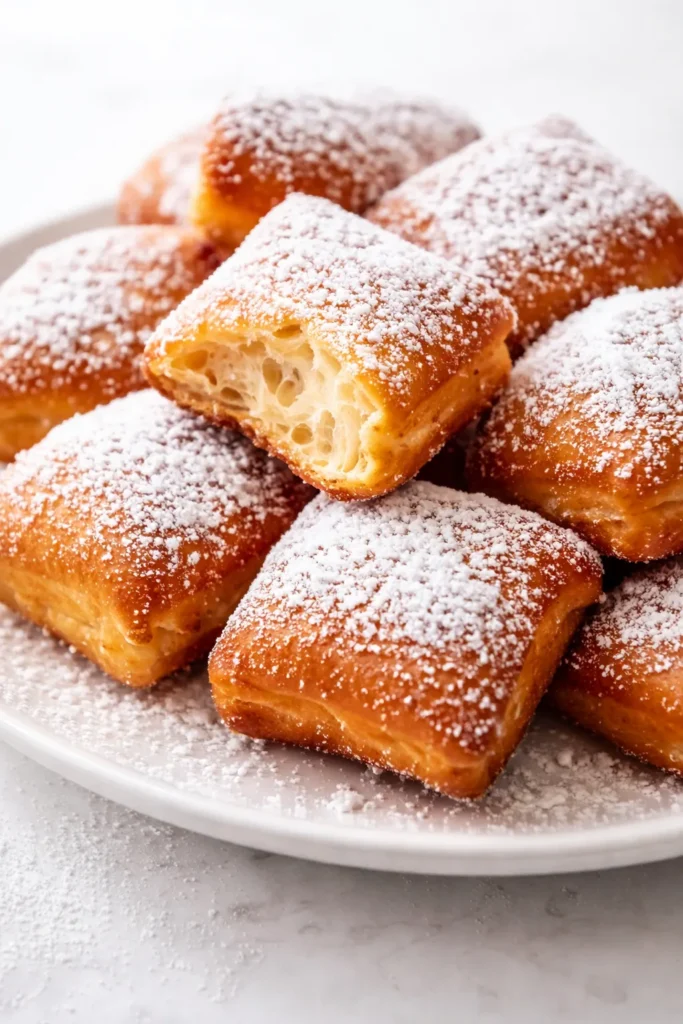
The smell of hot oil and real vanilla rolling through the house on a Saturday morning — that’s the smell of Celestine’s kitchen, and it’s the smell I chase every single time I make these beignets. Light, crisp, puffed up like little pillows, with a shower of powdered sugar that gets all over your shirt and you honestly don’t care.
The short version: These are the homemade beignets that actually taste like the ones from the Café, with real vanilla specks in every single bite.
I’ve been making this recipe since I was tall enough to reach the counter. I’ve tweaked the flour ratio and the vanilla situation, but the core is pure Celestine. My daughter Simone has officially declared them “better than the airport ones,” which is the highest compliment she can give.
- Serves: Makes about 15-18 beignets (serves 4-6)
- Hands-On Time: 30 min | Total Time: 2 hrs (includes rising)
- Difficulty: Medium — it’s a yeast dough, but I promise it’s simpler than it sounds.
- Cost per serving: ~$0.80
- Calories: ~280 per serving (2 beignets)
- Dietary Notes: Contains dairy and gluten. No nuts.
(Photo above: overhead shot of a wooden cutting board covered in a thick layer of powdered sugar, golden brown beignets piled high, steam rising from the stack, a small cup of dark chicory coffee in the corner, soft morning light from a window.)
The Secret to Light, Airy Beignets at Home
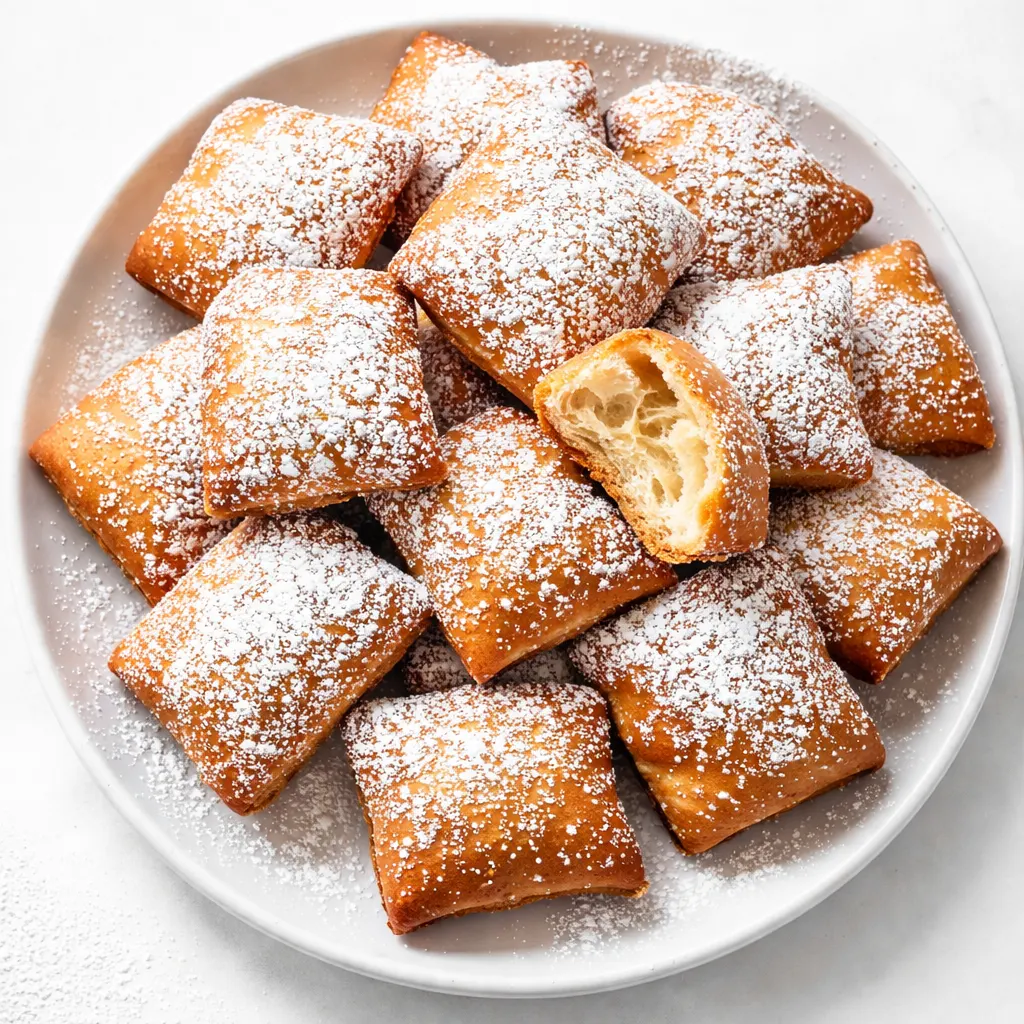
The magic here is in the dough hydration. This is a sticky dough — wetter than you think it should be. When it hits the hot oil, all that water turns to steam, which is what gives you that hollow, airy center. If you add too much flour to make it easy to handle, you’ll get a dense, bread-y beignet. And nobody wants that.
The other trick is the evaporated milk. Celestine used it in everything from biscuits to pancakes. It adds a subtle richness without making the dough heavy. It’s what makes the inside taste tender, not tough.
Oh, and the vanilla? We’re using real vanilla bean paste or a split bean. Not just extract. Trust me — you want those little black specks. That’s the flavor.
What You Need (Plus My Honest Notes)
- 1 1/2 cups warm water (110°F): This is lukewarm. Hot enough to wake the yeast up, but not so hot it kills it.
- 1 tablespoon active dry yeast: Or one packet. Instant yeast works too — just skip the blooming step and mix it straight into the flour.
- 1/2 cup granulated sugar: Divided. A little goes into the yeast, the rest into the dough.
- 1 teaspoon salt: Don’t skip it. It balances the sweetness and controls the yeast.
- 2 large eggs: Room temperature. Cold eggs will shock the dough.
- 1/2 cup evaporated milk: This is the non-negotiable ingredient. It makes the beignets tender.
- 1/4 cup unsalted butter, melted: For richness.
- 2 teaspoons vanilla bean paste: Splurge on the good stuff. Or one vanilla bean, scraped. This is where the flavor lives.
- 4 1/2 cups bread flour: Bread flour gives the structure the steam needs to puff up. All-purpose works in a pinch but won’t be as tall.
- Oil for frying: Peanut or vegetable. Peanut oil gives the best neutral flavor.
- Powdered sugar for dusting: A lot of it. Seriously. Don’t hold back.
What to Pull Out Before You Start
- A large mixing bowl or the bowl of a stand mixer.
- A dough hook (if using a mixer) or a strong wooden spoon.
- A heavy pot or Dutch oven for frying. I use a 6-quart Dutch oven.
- A deep-fry thermometer. You need this. Guessing the oil temperature is how you end up with greasy beignets.
- A rolling pin.
- A sharp knife or pizza cutter.
- A sheet tray lined with parchment or a silicone mat.
Let’s Make Beignets (My Exact Process)
This dough comes together fast. Read through once so you know where you’re going.
- Bloom the yeast: In the bowl of your stand mixer, combine the warm water, 1 tablespoon of the sugar, and the yeast. Let it sit for 5 minutes until it’s foamy. If it doesn’t foam, your yeast is dead. Start over.
- Mix the wet ingredients: Add the remaining sugar, salt, eggs, evaporated milk, melted butter, and vanilla bean paste to the yeast mixture. Whisk it by hand until it’s combined.
- Add the flour: With the dough hook on low speed, add the bread flour 1 cup at a time. It’s going to look shaggy and wet. That’s what we want.
(📸 Photo tip: The dough should look sticky and rough, not smooth and dry. If it pulls away from the bowl slightly but still sticks to your finger, that’s the sweet spot.) - Knead: Knead on medium-low speed for about 5-6 minutes. The dough will become smoother but will still be soft and slightly tacky. Don’t be tempted to add more flour.
- First Rise: Place the dough in a lightly oiled bowl, cover with plastic wrap or a clean kitchen towel, and let it rise in a warm place until doubled. This takes about 1 hour.
(📸 Photo tip: After an hour, it should look puffy and pillowy. Press a finger in — if the indentation stays, it’s ready.) - Shape the beignets: Punch the dough down gently. Turn it out onto a lightly floured surface. Roll it out into a 1/4-inch thick rectangle. Use a pizza cutter to cut it into 2.5-inch squares.
- Second Rise: Place the squares on a parchment-lined baking sheet, cover them loosely with plastic wrap, and let them rise for another 30 minutes. They’ll puff up noticeably.
- Heat the oil: Fill your Dutch oven with about 2 inches of oil. Heat it to 350°F (175°C). Use that thermometer.
- Fry: Gently drop a few beignets into the hot oil. Don’t crowd the pot. They’ll sink, then float. Fry for 1-2 minutes per side until deep golden brown. The bubbles around them should be steady and vigorous.
- Drain and coat: Transfer them to a paper-towel lined plate for about 30 seconds. Then, while they’re still hot, toss them in a bowl of powdered sugar or pile them on a plate and shower them with sugar.
How I Make These for Mardi Gras Morning (Ahead of Time)
Beignets are best hot and fresh, but I know mornings are chaos. I make a double batch, cut them into squares, and freeze them on a sheet tray. Once frozen, I toss them into a freezer bag. On Saturday morning, I pull out exactly how many we want, let them sit on the counter for 20 minutes while the oil heats, and fry them straight from a partial thaw. They come out exactly as puffy.
- Fridge: I don’t recommend storing fried beignets in the fridge. They get soggy. Make the dough ahead and fry fresh.
- Freezer: Yes! Freeze the cut, unbaked squares on a tray, then store in a bag for up to 3 months.
- Reheat: If you have leftover fried beignets (rare in my house), reheat them in a 350°F oven for 5 minutes. Not the microwave. The microwave turns them into shoes.
Things I Wish I Knew the First Time I Made These
- Don’t skip the second rise: I know you’re hungry. I know the oil is hot. But that second rise is what makes the inside hollow and light. If you skip it, you’ll get a dense, doughy beignet.
- Watch the oil temp: If the oil is too cold, the beignets soak it up like a sponge and you get greasy sticks. If it’s too hot, they burn on the outside and stay raw inside. 350°F is the number. Trust the thermometer.
- Flour your cutter: The dough is sticky. Dip your cutter in flour between cuts to keep the squares clean. Ragged edges fry up unevenly.
- Sugar immediately: The powdered sugar only sticks if the beignets are hot out of the oil. If you wait, you’ll end up with naked beignets. And what’s the point of a naked beignet?
Swaps and Twists That Actually Work
- Gluten-Free: Use a high-quality 1-to-1 gluten-free flour blend like Cup4Cup. The texture will be slightly more tender, but they’ll still puff beautifully.
- Lemon-Ricotta Beignets: Add the zest of one lemon and replace 1/4 cup of the flour with 1/4 cup of whole milk ricotta. These are less traditional but incredible.
- Chocolate Version: Drizzle melted dark chocolate over the powdered sugar. My kids think this is the only way. I don’t disagree.
- Savory Beignets: Cut the sugar to 1 tablespoon, skip the vanilla, and add a teaspoon of black pepper and a cup of grated Gruyère. Fry as directed and serve with honey. It’s weird and amazing.
Questions People Always Ask Me About Beignets
Q: Why didn’t my beignets puff up?
A: 99% of the time, it’s one of two things: your yeast was dead (it didn’t foam in the water) or you added too much flour. Next time, weigh your flour or spoon it gently into the cup. A dry dough won’t steam properly.
Q: Can I use instant yeast instead of active dry?
A: Yes! Use the same amount and mix it directly into the flour. Skip the blooming step in Step 1. You’ll need one slightly longer rise — about 90 minutes for the first rise.
Q: How do I store leftover beignets?
A: Store them in a paper bag (not plastic) at room temperature for up to 2 days. To re-crisp them, pop them in a 350°F oven for 5 minutes. The powdered sugar will melt into the top, so add another dusting before serving.
Q: What do you serve with beignets?
A: A strong cup of chicory coffee with milk is the traditional answer. But in my house, we do a cold glass of milk for Simone and a hot café au lait for me. They’re also incredible with fresh strawberries in the spring.
More Recipes My Family Makes on Repeat
If you loved these, you’ll love the rest of the New Orleans-inspired recipes we keep in heavy rotation:
- [INTERNAL LINK PLACEHOLDER: New Orleans King Cake] — The Mardi Gras centerpiece, with cinnamon sugar and cream cheese.
- [INTERNAL LINK PLACEHOLDER: Bananas Foster Skillet] — Caramelized bananas in a buttery rum sauce. Takes 15 minutes.
- [INTERNAL LINK PLACEHOLDER: Celestine’s Pralines] — The famous pecan pralines that only take 20 minutes to set.
Making beignets at home feels like a special occasion, but it’s honestly just a regular Saturday in my kitchen once you get the hang of it. The dough is forgiving, the frying is fast, and the payoff is a pile of warm, pillowy, vanilla-flecked squares that disappear faster than you can make them.
If you make them, tag me on Pinterest or Instagram — I want to see your powdered sugar mustaches.
📌 Homemade vanilla beignets recipe that puffs up perfectly every time — save this for your next Mardi Gras party or a lazy weekend breakfast that feels like New Orleans.

My Grandmother’s New Orleans Beignets (Vanilla, Airy, and Worth Every Minute)
Equipment
- Large mixing bowl or stand mixer bowl
- Dough hook (if using mixer) or wooden spoon
- Heavy pot or Dutch oven (6-quart)
- Deep-fry thermometer
- Rolling Pin
- Sharp knife or pizza cutter
- Sheet tray lined with parchment or silicone mat
Ingredients
- 1 1/2 cups warm water (110°F)
- 1 tablespoon active dry yeast (or 1 packet)
- 1/2 cup granulated sugar, divided
- 1 teaspoon salt
- 2 large eggs, room temperature
- 1/2 cup evaporated milk
- 1/4 cup unsalted butter, melted
- 2 teaspoons vanilla bean paste (or 1 vanilla bean, scraped)
- 4 1/2 cups bread flour
- oil for frying (peanut or vegetable)
- powdered sugar for dusting (a lot)
Instructions
- Bloom the yeast: In the bowl of your stand mixer, combine the warm water, 1 tablespoon of the sugar, and the yeast. Let it sit for 5 minutes until it’s foamy. If it doesn’t foam, your yeast is dead — start over.
- Mix the wet ingredients: Add the remaining sugar, salt, eggs, evaporated milk, melted butter, and vanilla bean paste to the yeast mixture. Whisk it by hand until combined.
- Add the flour: With the dough hook on low speed, add the bread flour 1 cup at a time. The dough will look shaggy and wet — that is exactly what we want. It should be sticky and rough, not smooth and dry.
- Knead: Knead on medium-low speed for 5-6 minutes. The dough will become smoother but will still be soft and slightly tacky. Do not add more flour.
- First rise: Place the dough in a lightly oiled bowl, cover with plastic wrap or a clean kitchen towel, and let it rise in a warm place until doubled, about 1 hour. Press a finger in — if the indentation stays, it’s ready.
- Shape the beignets: Punch the dough down gently. Turn it out onto a lightly floured surface. Roll it out into a 1/4-inch thick rectangle. Use a pizza cutter to cut into 2.5-inch squares.
- Second rise: Place the squares on a parchment-lined baking sheet, cover loosely with plastic wrap, and let them rise for another 30 minutes. They will puff up noticeably.
- Heat the oil: Fill your Dutch oven with about 2 inches of oil. Heat to 350°F (175°C). Use a thermometer.
- Fry: Gently drop a few beignets into the hot oil — do not crowd the pot. They will sink, then float. Fry for 1-2 minutes per side until deep golden brown. The bubbles around them should be steady and vigorous.
- Drain and coat: Transfer to a paper-towel lined plate for about 30 seconds. While still hot, toss them in a bowl of powdered sugar or pile them on a plate and shower them with sugar. Serve immediately.
Notes
Related posts:
 Baked Protein Pancake Bowls That Don’t Taste Like Cardboard — Finally
 Easy High-Protein Philly Cheesesteak Mac That Beats Takeout Every Time (30 Minutes)
 Italian Sausage Orzo That’s a One-Pot Weeknight Savior (Ready in 45 Minutes)
 Creamy Tuscan Gnocchi That Tastes Like a Slow Sunday in Italy — in Under 30 Minutes