
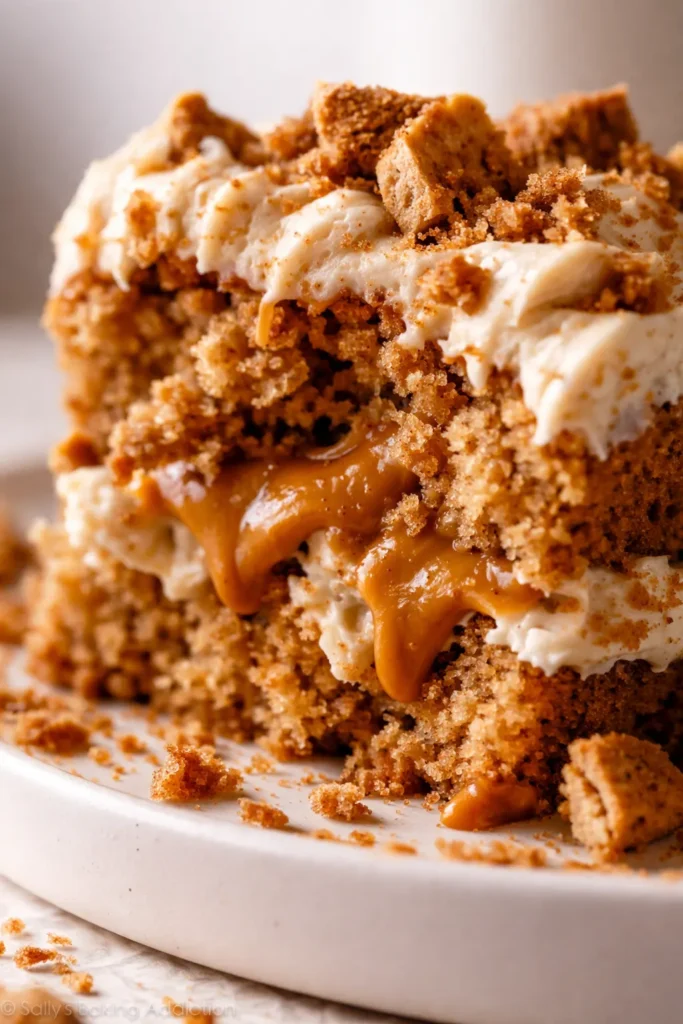
That first bite — where the spiced brown sugar cake crumbles gently against the silkiest cookie butter frosting you’ve ever tasted — is the exact moment this Biscoff cake stops being “just a recipe” and becomes your new signature dessert. I’ve tested this cake six times to get that perfect balance of warm cinnamon, deep caramelized sugar, and that unmistakable Biscoff crunch. My neighbors have stopped asking what I’m baking. They just show up with forks.
The first version of this cake was a disaster — dry, dense, and the cookie butter flavor completely disappeared into the crumb. I went back to the kitchen and swapped whole eggs for just egg whites, added oil for extra moisture, and brushed the baked layers with warm cookie butter. That soak changed everything. The third version was so moist my husband actually asked if I was trying to make him propose again. This is that version.
- Serves: 12–14 as a layer cake
- Hands-On Time: 45 min | Total Time: 2 hrs 30 min
- Difficulty: Intermediate — multiple components, but each is simple on its own
- Cost per serving: ~$2.50
- Nutrition Estimate: 545 Calories, 6g Protein, 68g Carbs, 28g Fat, 16g Saturated Fat, 1g Fiber, 320mg Sodium per serving
- Dietary Notes: Vegetarian
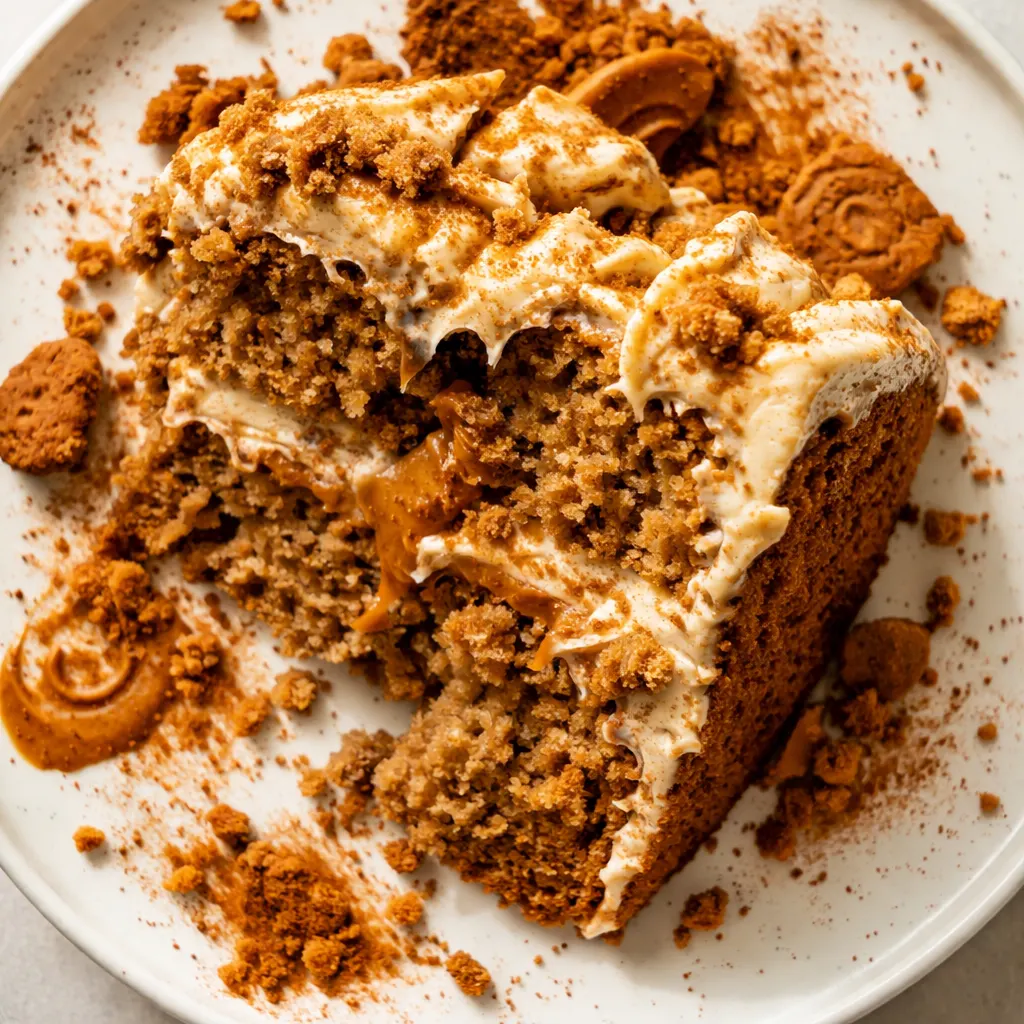
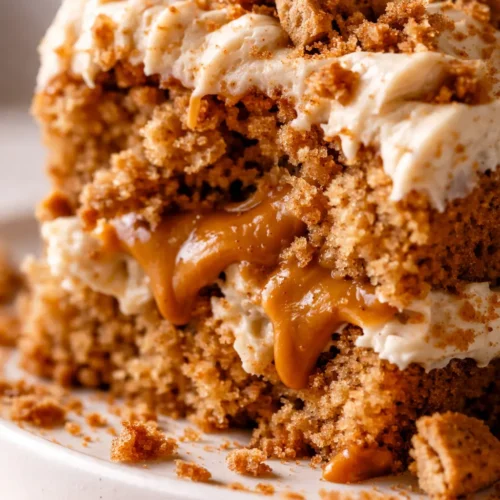
(Photo above: A tall three-layer Biscoff cake on a vintage cake stand, sliced to reveal the cookie butter filling between each layer. The frosting is swirled high and topped with crushed Biscoff cookies and a generous drizzle of melted cookie butter. Soft natural window light, slightly warm tones, on a rustic wooden table.)
Most Biscoff cakes rely entirely on the spread for flavor, which often leaves the cake tasting flat. This recipe builds flavor from the ground up with dark brown sugar and cinnamon right in the batter. The buttermilk keeps the crumb incredibly tender while adding a subtle tang that perfectly balances the sweetness of the cookie butter. According to USDA nutritional data, the butter in the frosting provides rich fat-soluble vitamins, but it’s the careful emulsification with the cream that creates that silky, spreadable texture we’re after.
I also know that most home bakers find that room temperature ingredients — around 70–72°F — blend together much more evenly than cold ones. That single detail is what prevents a dense, hockey-puck cake.
Biscoff Cake Ingredients: The Ones That Actually Matter
- 3 cups all-purpose flour (375g): Spoon and level it carefully — too much flour is the number one reason homemade cakes turn out dry.
- 1 cup granulated sugar (200g) + 2 cups packed dark brown sugar (400g): Dark brown sugar has more molasses, giving a deeper flavor that plays beautifully with Biscoff. Don’t have dark? Light works too, but dark is worth seeking out.
- 2½ tsp baking powder (10g): Make sure it’s fresh. If it doesn’t fizz when you drop a bit in water, get a new can.
- 2 tsp ground cinnamon (5g): This bridges the gap between the cake and the cookie butter flavor.
- 1 tsp fine salt (6g): Balances the sweetness. Essential in any layer cake.
- 1 cup (2 sticks) unsalted butter, room temperature (226g): For tenderness. Cold butter won’t cream properly and leads to a dense crumb.
- 1 cup carton egg whites or 7 large egg whites, room temperature (240g): Egg whites keep the cake light and tender without weighing it down like yolks can. Cold egg whites will seize the butter, so set them out early.
- 1½ cups buttermilk, room temperature (360g): The acid in buttermilk tenderizes the gluten and activates the baking powder for maximum lift.
- 2 Tbsp vegetable or canola oil (28g): This is my secret weapon for extra moisture. It stays tender longer than butter alone.
- 2 tsp vanilla extract or vanilla bean paste (8g): Enhances the warm spices without overpowering them.
- 3 cups (6 sticks) unsalted butter, room temperature (678g): The foundation of the frosting. It needs to be soft but not greasy. Aim for 65–67°F if you use a thermometer.
- 1 Tbsp vanilla extract or vanilla bean paste (12g): For the buttercream. Yes, this is more than usual. It helps cut through the sweetness.
- 1½ tsp fine salt (9g): For the frosting. Don’t skip it — salt is what makes a buttercream taste homemade rather than like pure sugar.
- 10 cups powdered sugar (1250g): Sift it if it’s lumpy. Lumpy sugar makes lumpy frosting.
- ¾ cup heavy whipping cream, room temperature (180g total): Divided into ½ cup for the vanilla frosting and ¼ cup for the cookie butter soak.
- 2 cups cookie butter (780g total): Divided — 1 cup goes into the frosting, 1 cup goes into the soak between the layers. This is non-negotiable for maximum flavor.
- 12 Biscoff cookies (cut into small pieces): For the iconic crunchy topping. Add more if you’re a texture lover like me.
What to Pull Out Before You Start
- Three 8-inch round cake pans (9-inch works too, just reduce baking time slightly)
- Stand mixer with paddle attachment (a hand mixer works, but your arm will get a workout)
- Parchment paper rounds
- Serrated knife for leveling the layers
- Offset spatula for frosting
- Cake turntable (optional but makes frosting so much easier)
Let’s Make This Biscoff Cake (Step by Step)
Okay, here’s exactly how I do it. The smell of cinnamon and brown sugar filling your kitchen is the first sign you’re making something special. Take it step by step, and you’ll be eating the best cake of your life by dinner time.
Prep the oven and pans: Preheat your oven to 350°F (177°C). Grease three 8-inch cake pans and line the bottoms with parchment paper rounds. Dust the sides with a little flour and tap out the excess.
- Whisk the dry ingredients: In a medium bowl, whisk together 3 cups all-purpose flour, 2½ tsp baking powder, 2 tsp cinnamon, and 1 tsp fine salt. Set this aside. The cinnamon will smell warm and inviting.
- Cream the butter and sugars: In your stand mixer fitted with the paddle attachment, beat 1 cup (2 sticks) room temperature butter, 1 cup granulated sugar, and 2 cups packed brown sugar on medium-high speed for a full 3–4 minutes. Scrape the bowl once or twice. It should look light, fluffy, and noticeably paler — almost like a cloud. The aroma will be pure caramel. You’ll hear the mixer’s sound change as air is incorporated.
- Add the wet ingredients: Turn the mixer down to low. Add 2 Tbsp oil, 2 tsp vanilla, and the 1 cup of room temperature egg whites in a slow, steady stream. Mix until just combined — don’t rush this part or the mixture might look curdled. If it does look like cottage cheese for a second, don’t panic; keep mixing on medium-low until it comes back together.
- Alternate dry and buttermilk: Add the flour mixture in three additions, alternating with the 1½ cups buttermilk. Start and end with the flour. Mix on low until just a few streaks of flour remain. Finish folding by hand with a rubber spatula to avoid overmixing. Overmixing develops gluten, making the cake tough.
- Bake the layers: Divide the batter evenly among the three pans (a kitchen scale helps here — about 640g per pan). Bake for 22–27 minutes. The cakes should spring back lightly when touched, and a toothpick inserted in the center should come out clean or with just a few moist crumbs. Your kitchen will smell like a bakery — that warm, spiced aroma you’ll want to bottle.
- Cool completely: Let the cakes rest in the pans for 10 minutes. Run a knife around the edge, then turn them out onto a wire rack. Peel off the parchment and let them cool completely — at least 1 hour. Patience here is key; warm layers will melt your frosting later. The layers will be tender and fragrant.
- Make the vanilla buttercream: In your clean mixer bowl with the paddle attachment, beat 3 cups (6 sticks) room temperature butter on medium speed for 2 minutes until smooth and shiny. Add 1 Tbsp vanilla and 1½ tsp salt. Gradually add 10 cups powdered sugar, one cup at a time, on low speed — watch for flying sugar clouds. Add ½ cup heavy cream and mix on low until incorporated, then whip on medium-high for 3–4 minutes until light and fluffy. You’re looking for a stiff peak that holds its shape.
- Make the cookie butter frosting and soak: Reserve about 1½ cups of the vanilla buttercream (you’ll use this for a hidden white layer if you want, or just eat it). To the remaining buttercream, add 1 cup cookie butter and mix until well combined. In a small saucepan, warm the other 1 cup of cookie butter with ¼ cup heavy cream over low heat, stirring until smooth and pourable — this is your magic soak and drip. It will smell like warm, spiced cookies.
- Assemble the cake: Place one cooled layer on your serving plate. Use a pastry brush to generously soak it with the warm cookie butter mixture — it should glisten. Spread about ½ cup of cookie butter frosting over it. Repeat with the second and third layers. Apply a thin crumb coat to the entire cake and refrigerate for 20–30 minutes until the frosting is set. This step seals in crumbs and makes your final coat flawless.
- Frost and decorate: Apply the final generous layer of cookie butter frosting. Top with crushed Biscoff cookie pieces and drizzle with the remaining cookie butter soak. Let the cake sit at room temperature for 30 minutes before slicing for the cleanest cuts. That first slice will reveal perfect layers of cake, soak, and frosting — absolute magic.
How I Make This Biscoff Cake Ahead of Time
Honestly, this cake is better on day two. The flavors have time to marry, and the texture somehow gets even more tender. I always make it the night before a party — it’s one less thing to stress about.
- Fridge: Store the assembled cake in an airtight cake carrier in the fridge for up to 5 days. Let it sit at room temp for 20–30 minutes before serving to soften the frosting.
- Freezer: Yes! You can freeze the un-iced cake layers tightly wrapped in plastic and foil for up to 3 months. The cookie butter frosting also freezes beautifully in a zip-top bag — thaw in the fridge and re-whip briefly.
- Reheat: No reheating needed. If you absolutely must have a warm slice, 10 seconds in the microwave is plenty.
I’ve Made This 6 Times — Here’s What I Learned
- Room temperature is not a suggestion — it’s a rule: I know it’s annoying to wait, but cold egg whites or buttermilk will seize the butter and create a dense, unmixable batter. Set everything out on the counter 1–2 hours before you start. Touch the butter: if it dents easily with a finger, it’s ready.
- Don’t overmix the batter: Once you add the flour, mix on low until just combined. Overmixing develops gluten, which makes the cake tough and domed. A few streaks of flour are fine — fold them in by hand.
- The cookie butter soak is the hero: Warm that second cup of cookie butter with the cream until it’s pourable. Brush it over every layer. This is what makes every single bite taste intensely of Biscoff. Even if you mess up the frosting, this soak will save you.
- Crumb coating is worth the extra 10 minutes: A thin “crumb coat” of frosting seals in the loose crumbs so your final layer is perfectly smooth. Chill it for 20 minutes before the final coat. Makes a huge difference visually.
Swaps That Actually Work (For When You’re in a Pinch)
- No buttermilk? Use 1½ cups whole milk + 1½ Tbsp lemon juice or white vinegar. Let it sit for 5 minutes until it curdles. Works perfectly in this recipe.
- Want it spicier? Add ½ tsp nutmeg and ¼ tsp ground cloves to the dry ingredients. It gives a holiday-spiced warmth that’s gorgeous in fall.
- Only have crunchy Biscoff spread? Use it for the soak between the layers! The texture is wonderful there. Stick with smooth for the frosting so it stays silky.
- Buttercream is too thick? Add 1 Tbsp of cream at a time until it reaches your desired consistency. If it’s too thin, pop the bowl in the fridge for 10 minutes and re-whip.
Why Did My Biscoff Cake Sink in the Middle?
Q: Why did my cake layers dome or sink?
A: Oven temperature is usually the culprit. Your oven might run hot (causing a dome) or not be hot enough (causing a sink). An oven thermometer is a $10 fix that will change your baking forever. Also, make sure your baking powder is fresh.
Q: Can I use salted butter instead of unsalted?
A: You can, but omit the added salt in both the cake and frosting. I prefer unsalted so I can control the exact salt level. Salted butter can vary wildly in salinity.
Q: Can I make this as a two-layer cake instead of three?
A: Absolutely. Use two 9-inch pans instead of three 8-inch. Bake for 25–30 minutes. The rest of the recipe stays the same — just have slightly thicker layers.
Q: My frosting looks curdled. What happened?
A: The butter was too cold or too warm. If it’s too cold, the butter won’t emulsify with the cream. Set your bowl over a warm water bath for 10 seconds then re-whip. If it’s too warm (greasy-looking), pop the whole bowl in the fridge for 15 minutes and re-whip.
This Biscoff cake has become my go-to for birthdays, holidays, and “just because” Sundays. The combination of tender spiced layers, that irresistible cookie butter soak, and the creamy frosting is genuinely unforgettable. I hope you make it and love it as much as I do. Happy baking!
Biscoff Cake with Cookie Butter Frosting That Stays Moist for Days (The Only Layer Cake Recipe You Need)
Equipment
- Three 8-inch round cake pans
- Stand mixer with paddle attachment
- Parchment paper rounds
- Serrated Knife
- Offset spatula
- Cake turntable
Ingredients
Cake
- 3 cups all-purpose flour spoon and level (375g)
- 1 cup granulated sugar (200g)
- 2 cups packed dark brown sugar (400g)
- 2.5 teaspoons baking powder (10g)
- 2 teaspoons ground cinnamon (5g)
- 1 teaspoon fine salt (6g)
- 1 cup unsalted butter room temperature, 2 sticks (226g)
- 1 cup egg whites room temperature, or 7 large egg whites (240g)
- 1.5 cups buttermilk room temperature (360g)
- 2 tablespoons vegetable oil or canola oil (28g)
- 2 teaspoons vanilla extract or vanilla bean paste (8g)
Cookie Butter Frosting and Soak
- 3 cups unsalted butter room temperature, 6 sticks (678g)
- 1 tablespoon vanilla extract or vanilla bean paste (12g)
- 1.5 teaspoons fine salt (9g)
- 10 cups powdered sugar sift if lumpy, 1250g
- 0.75 cup heavy whipping cream room temperature, divided (1/2 cup for frosting, 1/4 cup for soak, 180g total)
- 2 cups cookie butter divided (1 cup for frosting, 1 cup for soak, 780g total)
- 12 Biscoff cookies cut into small pieces for topping
Instructions
- Preheat your oven to 350°F (177°C). Grease three 8-inch cake pans and line the bottoms with parchment paper rounds. Dust the sides with a little flour and tap out the excess.
- In a medium bowl, whisk together 3 cups all-purpose flour, 2½ tsp baking powder, 2 tsp cinnamon, and 1 tsp fine salt. Set aside.
- In the bowl of a stand mixer fitted with the paddle attachment, beat 1 cup (2 sticks) room temperature butter, 1 cup granulated sugar, and 2 cups packed brown sugar on medium-high speed for 3–4 minutes until light and fluffy. Scrape the bowl once or twice.
- Turn the mixer to low. Add 2 Tbsp oil, 2 tsp vanilla, and 1 cup room temperature egg whites in a slow, steady stream. Mix until just combined.
- Add the flour mixture in three additions, alternating with 1½ cups buttermilk, starting and ending with flour. Mix on low until a few streaks of flour remain, then fold by hand with a rubber spatula until just combined.
- Divide the batter evenly among the three pans (about 640g per pan). Bake for 22–27 minutes until the cakes spring back lightly and a toothpick inserted in the center comes out clean or with a few moist crumbs. Let cool in pans for 10 minutes, then turn out onto a wire rack to cool completely.
- Make the vanilla buttercream: In a clean mixer bowl with the paddle attachment, beat 3 cups (6 sticks) room temperature butter on medium speed for 2 minutes until smooth. Add 1 Tbsp vanilla and 1½ tsp salt. Gradually add 10 cups powdered sugar, one cup at a time, on low speed. Add ½ cup heavy cream and mix until incorporated, then whip on medium-high for 3–4 minutes until light and fluffy.
- Reserve about 1½ cups of the vanilla buttercream for another use (or eat it). To the remaining buttercream, add 1 cup cookie butter and mix until combined. In a small saucepan, warm the other 1 cup cookie butter with ¼ cup heavy cream over low heat, stirring until smooth and pourable — this is your soak and drip.
- Place one cooled cake layer on a serving plate. Use a pastry brush to generously soak it with the warm cookie butter mixture. Spread about ½ cup of cookie butter frosting over it. Repeat with the second and third layers. Apply a thin crumb coat to the entire cake and refrigerate for 20–30 minutes until set.
- Apply the final generous layer of cookie butter frosting. Top with crushed Biscoff cookie pieces and drizzle with the remaining cookie butter soak. Let the cake sit at room temperature for 30 minutes before slicing.
Notes
Related posts:
 This Raspberry Lemon Cake With White Chocolate Is the Only Layer Cake You Need for Spring Celebrations
 Peach Cobbler That Bakes Its Own Crust (Golden, Juicy, 40 Minutes)
 Snickerdoodle Zucchini Bread That’s Moist, Swirled, and Secretly Good for You
 The Gluten-Free Chocolate Zucchini Bread You’d Never Guess Is Gluten-Free (It’s Rich, Moist & Impossible to Stop Eating)